
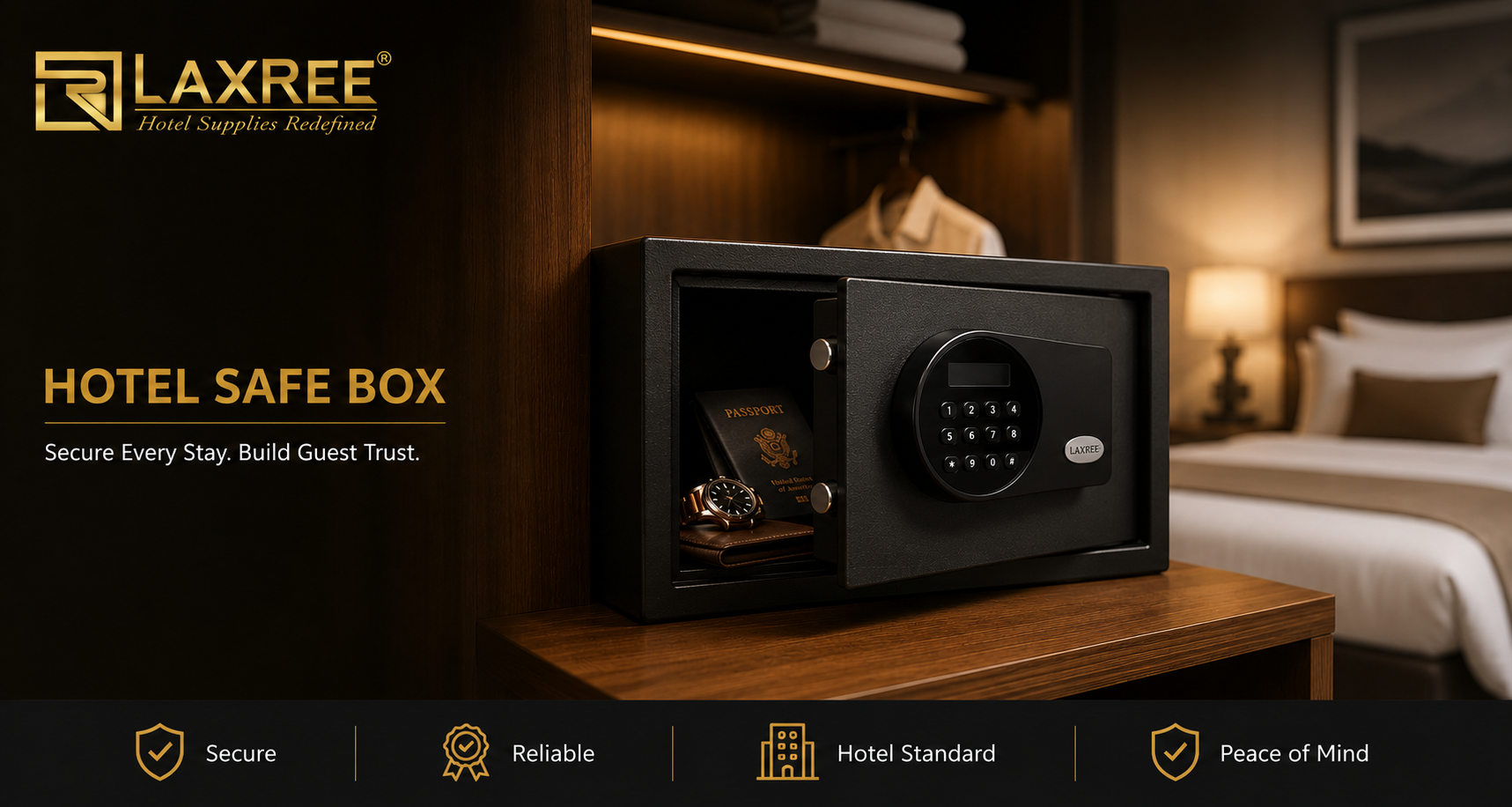
Introduction: The In-Room Safe Is a Trust Product — And Trust Has Specifications
Every guest who places their passport, laptop, jewellery, or cash in a hotel room safe is making a trust decision. They are trusting that the safe will function when they need it, that it is genuinely secure against opportunistic access, and that it will not malfunction and trap their belongings inside when they need to check out in 20 minutes.
That trust decision — and the guest experience it either confirms or betrays — is entirely determined by the quality of the procurement decision made months or years earlier, when someone in the hotel’s purchase team chose which safe box to install.
Hotel safe boxes are one of the most under-specified product categories in Indian hospitality procurement. Most purchase decisions in this category are made on two criteria alone: size and price. The technical specifications that determine whether a safe functions reliably for 8–10 years of commercial hotel use — locking mechanism quality, steel gauge, override system design, battery management, and compliance with relevant security standards — are rarely evaluated in depth, and their absence from the procurement decision is what produces the most frustrating in-room amenity failure in hospitality: a guest locked out of their own safe, or a safe that has failed electronically and cannot be opened without a master override that nobody on the current shift knows how to locate.
This guide gives hotel owners and purchase managers the technical framework to specify, evaluate, and procure hotel safe boxes correctly — from lock type selection through installation requirements and B2B bulk procurement strategy.
Part 1: Why the Hotel Safe Box Is Different From a Home Safe
The first and most important distinction in hotel safe box procurement is the difference between a residential safe and a commercial hotel-grade safe. They look similar in product photographs. They are fundamentally different in design intent.
Commercial Use Demands
A residential safe is used by one household — perhaps 50–100 lock/unlock cycles per year, by people familiar with the specific safe’s behaviour, who can refer to the manual when needed.
A hotel room safe is used by a different person every 1–3 nights — anywhere from 150 to 365 different users per year, each encountering the safe for the first time, under the stress of travel, often in low light, often in a hurry. Each user may enter an incorrect code, forget their code, leave items inside accidentally, or try to force-open the safe in frustration.
Under these conditions, a residential safe’s lock mechanism, battery management, and override system — all designed for gentle, informed, low-frequency use — degrades and fails at a rate that makes it commercially unviable in a hotel room.
Commercial hotel safe box requirements:
- Lock mechanism rated for minimum 10,000 open/close cycles without failure
- Battery management designed for continuous standby drain plus 365+ active cycles per year
- Override system that front desk and maintenance staff can operate quickly and reliably
- Construction that resists opportunistic forced entry without requiring vault-grade steel thickness
- Electronic components that function across the temperature and humidity range of Indian hotel rooms (including AC failure periods, coastal humidity, and seasonal temperature variation)
Part 2: Hotel Safe Box Types — Complete Technical Comparison
Type 1: Electronic Keypad Safe (Digital Safe)
The most widely deployed safe type in Indian hotels — a digital keypad where the guest sets a 3–8 digit PIN code to lock and unlock.
How it works: Guest sets a numeric code at start of stay. The code is active until the safe is opened — at which point it resets for the next guest (or requires manual reset by housekeeping, depending on the model). The electronic lock engages a steel bolt mechanism when the code is entered.
Technical specifications to evaluate:
Keypad type:
- Membrane keypad (flat, sealed surface): More hygienic (no gaps for debris or moisture), more durable under high-frequency use, easier to clean. Recommended for hotel use.
- Mechanical button keypad: More tactile feedback, but buttons collect debris and wear faster under commercial use. Less recommended for hotel-grade specification.
Code length and lockout policy: A guest who forgets their code and enters incorrect attempts multiple times is a housekeeping incident waiting to happen. Specify safes with:
- Minimum 4-digit code (some hotel-grade models allow 3–8 digit codes set by the guest)
- Lockout delay after multiple incorrect attempts (typically 3–5 incorrect attempts triggers a 30–60 second lockout, preventing rapid guessing)
- But NOT a permanent lockout from incorrect attempts — this creates a maintenance emergency every time a guest forgets their code
Override system: The override system is the most critical specification for hotel operations — it is what the front desk or maintenance team uses when a guest forgets their code, when the battery dies with items inside, or when a guest has checked out and left items in a locked safe.
Types of override systems:
- Override keypad + master code: A secondary code known only to management unlocks the safe regardless of the guest’s code. Simple, reliable, requires no physical key. Most common in mid-range hotel safes. Risk: master code can be compromised if not managed carefully.
- Physical emergency key override: A separate physical key (stored at the front desk or in a secure management location) overrides the electronic lock. Reliable, but requires the key to be accessible and correctly managed.
- Emergency key + override code combination: Both a physical key and an electronic override code required simultaneously — highest security against unauthorised override. Appropriate for upscale and luxury properties.
Battery management: Hotel safes are battery-operated — typically 4 × AA alkaline batteries. Battery management considerations for hotel procurement:
- Low battery alert: The safe should provide a clear low battery warning (audible beep and/or LED indicator) before complete battery failure, giving housekeeping time to replace before a guest is locked in. Specify minimum 30 days of operational warning before failure.
- Power-out override capability: Even with a fully dead battery, the guest must be able to access their belongings. All hotel-grade safes should have a physical emergency power input (typically a 9V battery touch point on the exterior) that provides temporary power for one unlock cycle — allowing the safe to be opened even after battery failure.
- Battery life rating: Minimum 12 months at normal hotel usage frequency (150–365 cycles/year). Request documented battery life data — not just “long battery life” in a product description.
Type 2: Biometric Safe (Fingerprint Access)
A newer category gaining traction in upscale and luxury Indian hotel properties — the biometric safe uses fingerprint recognition for locking and unlocking, eliminating the need for the guest to remember a code.
How it works: At start of stay, the guest registers one or more fingerprints with the safe. The safe unlocks when a registered fingerprint is presented to the sensor. A PIN code or physical key backup is always provided for cases where fingerprint recognition fails.
Advantages for hotel use:
No forgotten code: The most common in-room safe problem — a guest who has forgotten their PIN — is eliminated. As long as the guest’s finger works, the safe opens.
Multiple user registration: Couples or small groups can each register their own fingerprint, allowing any registered guest to open the safe independently.
Premium perception: A biometric safe reads as a technology investment that signals quality and sophistication — a visible differentiator in photography and in the guest’s mental model of the room’s tech standard.
Technical considerations:
Wet or dirty finger recognition: Fingerprint sensors vary significantly in their ability to read wet, dry, or dirty fingers. Specify a sensor with a minimum 95% recognition rate across varied finger conditions — a sensor that fails to read a wet post-shower fingerprint is worse than a keypad safe.
Fingerprint data security: Guest fingerprint data should be stored locally in the safe’s memory and automatically deleted at the guest’s instruction or at a standard housekeeping reset — not transmitted to any external system. Confirm this data handling approach with the supplier in writing.
Registration speed: The initial fingerprint registration process should take under 10 seconds — a lengthy registration process creates friction at check-in when the housekeeping team is demonstrating the safe to the guest.
Suitable for: 4-star and 5-star properties, boutique properties with a technology forward positioning, and any property where the biometric safe can be positioned as a differentiating amenity feature rather than a standard fitting.
Type 3: Mechanical Lock Safe
A key-operated mechanical lock safe — no electronics, no battery, no digital components.
Advantages:
- Zero battery management requirement
- Zero electronic component failure risk
- Lowest unit cost
Limitations for hotel use:
- Physical key management is operationally complex at scale (each room requires a dedicated key; lost keys require lock replacement)
- No guest-settable code — the guest cannot personalise access; they depend entirely on the key provided
- No audit trail — no record of who opened the safe and when
Suitable for: Budget properties where the safe is a basic security provision rather than a feature. Properties in remote locations without reliable electronics maintenance support. Not recommended for 3-star and above.
Type 4: RFID Card Safe
A safe that uses the same RFID card technology as the room’s door lock — the guest uses their room keycard to lock and unlock the safe.
Advantages:
- Eliminates the “forgotten code” problem
- Integrates elegantly with the property’s existing RFID infrastructure
- Card loss automatically requires going to reception — which also resets safe access
Limitations:
- Card loss is simultaneously a room access and safe access problem
- Less commonly deployed in Indian market — fewer suppliers offer Indian-grade RFID safe integration
- Integration with specific RFID door lock systems requires compatibility confirmation
Suitable for: Properties with strong RFID ecosystem integration and a preference for unified access systems.
Part 3: Size Specifications — Matching Safe Capacity to Guest Profile
Safe box size is the specification most commonly underestimated in Indian hotel procurement. The standard compact safe box (typically 30cm × 20cm × 15cm) is adequate for cash, passports, and small jewellery — but inadequate for a business traveller’s laptop, which is now a near-universal item in the business travel kit.
The Laptop-Compatible Safe Requirement
A hotel that cannot accommodate a 15-inch laptop in its in-room safe is failing its business travel guest — a guest who has carried an expensive laptop across the country and now has nowhere secure to store it.
Laptop safe size requirements:
- Minimum interior width: 38cm (to accommodate a standard 15-inch laptop horizontally)
- Minimum interior depth: 28cm
- Minimum interior height: 6cm (to accommodate laptop plus thin accessories like a tablet)
Standard safe box interior dimensions — size guide:
| Safe Size | Interior Dimensions (approx.) | Suitable For |
|---|---|---|
| Mini | 25 × 18 × 10 cm | Passport, cash, phone, cards |
| Standard | 32 × 22 × 14 cm | Passport, small laptop (13″), camera |
| Laptop (A4) | 40 × 28 × 18 cm | 15″ laptop, tablet, documents |
| Large | 48 × 35 × 20 cm | Multiple items, large laptop, valuables |
Recommendation by property category:
| Property Category | Minimum Safe Size | Reasoning |
|---|---|---|
| Budget (1–2 star) | Mini / Standard | Basic cash/passport security |
| Midscale (3 star) | Standard | Mixed leisure/business guest base |
| Upper Midscale (4 star) | Laptop (A4) | Business traveller majority expectation |
| Premium/Luxury (5 star) | Laptop (A4) or Large | Mandatory laptop capability; large valuables |
The procurement mistake to avoid: Specifying a standard (32 × 22cm) safe for a 4-star property to save ₹1,500–₹2,500 per unit, then fielding complaints from every business traveller who cannot store their laptop — a complaint that appears in review language and in direct conversations with reception.
Part 4: Steel Construction and Security Rating — What Actually Determines Resistance
Hotel in-room safes are not designed to defeat a determined, tool-equipped attacker over extended time — that is vault-grade security, which is neither practical nor necessary in a hotel room context. They are designed to resist opportunistic forced entry — a thief who has brief, unsupervised access to the room and limited tools.
Steel Gauge — The Core Construction Specification
Safe security begins with the steel used in construction. Steel gauge (thickness) is the primary determinant of forced entry resistance.
Steel gauge guide for hotel safes:
| Steel Gauge | Wall Thickness | Suitable For |
|---|---|---|
| 18 gauge | 1.2mm | Minimum acceptable for hotel |
| 16 gauge | 1.6mm | Recommended for 3-star and above |
| 14 gauge | 1.9mm | Recommended for 4-star and above |
| 12 gauge | 2.6mm | Premium / upscale properties |
Bolt construction: The locking bolts — the physical steel pins that extend from the door into the frame when locked — determine the safe’s resistance to prying and pulling attacks.
- Number of bolts: Minimum 2 bolts (ideally 3) for hotel-grade security
- Bolt diameter: Minimum 15mm per bolt — thinner bolts can be sheared
- Anti-pry design: Live bolts (bolts that remain extended even when the door is forced) on all four sides of the door prevent the door being pried open from the hinge side
Anti-Theft Mounting Anchor
A safe that can be carried out of the room intact — even if it cannot be opened in place — provides incomplete security. All hotel in-room safes should have:
- Factory-fitted mounting holes: Pre-drilled holes in the base and/or back panel for anchoring to the shelf or wardrobe interior
- Anchor bolts included in supply: The mounting hardware should be included with the safe, not procured separately
- Installation instruction documentation: Clear, illustrated installation guide for correct anchoring — an unanchored safe, regardless of its electronic security, provides minimal theft deterrence
Part 5: Electronic and Audit Features — Specifications for Hotel Operations
Beyond the guest-facing lock and access function, hotel-grade safe boxes should support specific operational requirements.
Audit Trail Capability
A hotel-grade safe should maintain an internal log of recent access events — recording when the safe was opened, when an incorrect code was entered, and when the override was used. This audit capability is:
Operationally relevant: When a guest claims to have left valuables in the safe but the safe is empty at checkout, the audit log provides an objective record of access events during the stay.
Legally relevant: In the event of a guest claim of theft or safe malfunction, an audit log is the property’s primary evidential resource. A safe without an audit trail leaves the hotel in a he-said/she-said dispute with no objective record.
Minimum audit log requirement: Last 50 access events with timestamp. This should be accessible via the override/management interface without requiring manufacturer-level software.
Auto-Lock Feature
Some hotel safe models auto-lock after a defined period of the door being left open — preventing guests from leaving the safe in an open, unlocked state accidentally. This is a useful operational feature that reduces the incidence of guests locking themselves out by closing a door they assumed had already been locked.
Low Battery Communication to PMS
Premium hotel safe models can communicate low battery status to the property management system — flagging specific rooms where the safe battery needs replacement before the next guest checks in. This is a maintenance efficiency feature that eliminates the surprise battery failure mid-stay.
Part 6: Installation Requirements and Wardrobe Integration
Standard Installation Position
Hotel in-room safes are typically installed in one of three positions:
Wardrobe shelf installation (most common): The safe sits on a dedicated shelf within the wardrobe or cupboard — anchored to the shelf surface through the safe’s base mounting holes. This position keeps the safe out of the primary visual field of the room while being accessible and logical for guests.
Under-desk installation: The safe is mounted beneath the work desk — accessible while seated, less intrusive on wardrobe space. Used in rooms where wardrobe configuration does not provide adequate shelf space.
Dedicated safe niche: Built-in niche in the wardrobe or bedside cabinet specifically sized for the safe. Clean, integrated aesthetic — common in premium and luxury properties.
Wardrobe Shelf Specification for Safe Installation
When specifying wardrobes for new properties or renovation projects alongside safe box procurement, confirm:
- Shelf load rating: The safe’s weight when fully loaded (a large laptop safe with contents can weigh 10–15kg) plus the static load of anchoring forces must be within the shelf’s rated capacity
- Shelf depth: Adequate depth for the safe’s exterior dimensions (typically 40–50cm for a laptop-size safe)
- Power access: Some safes use external power supply as backup — if this option is specified, a power outlet within the wardrobe eliminates the need for a cable run to an external socket
Anchoring Procedure
Correct anchoring is a safety and security requirement — not an optional installation step. An unanchored safe can be removed from the property with contents intact, defeating the purpose entirely.
Correct anchoring procedure:
- Position safe in final location with clear access to mounting holes
- Mark drilling positions through the base mounting holes onto the shelf surface
- Pre-drill anchor holes with appropriate drill bit for the shelf material (wood: standard wood drill; MDF: sharp standard bit to prevent tear-out; metal shelf: metal drill bit)
- Insert wall plugs if required by shelf material
- Fasten anchor bolts through the safe’s mounting holes into the pre-drilled shelf holes
- Test completed installation by attempting to lift and rock the safe — any movement indicates inadequate anchoring
Part 7: B2B Bulk Procurement — Hotel Safe Box at Scale
Calculating Your Safe Box Requirement
Safe box procurement for a new property is straightforward: one safe per guest room. Unlike trolleys (where quantity is driven by operations) or linen (where quantity is driven by wash cycles), safe box quantity equals room count — plus a small buffer stock.
Buffer stock recommendation: 5–8% above room count for:
- Electronic component failures requiring temporary replacement
- Demonstration unit for front desk staff training
- Spare for any room where the installed safe requires removal for warranty service
For a 60-room hotel: 60 rooms + 4 buffer = 64 safe boxes to order
Volume Pricing at Hotel Scale
Safe box unit pricing at B2B volume (20+ units) is significantly below the retail market price. Expected B2B discount ranges for hotel safe box orders:
| Order Quantity | Expected Discount vs. Retail |
|---|---|
| 10–20 units | 12–18% |
| 21–50 units | 20–28% |
| 51–100 units | 28–35% |
| 100+ units | 35–42%+ |
For a 60-room property ordering 64 units, the total savings from B2B volume pricing versus individual retail purchase typically represent ₹60,000–₹1,50,000 — depending on the specification tier chosen.
Sample Testing Protocol Before Bulk Order
Functional testing (minimum 30 cycles over 5 days):
- Set and unlock the code 30 times — confirm consistent, smooth operation every cycle
- Enter an incorrect code 5 times — confirm lockout behaviour matches specification
- Test the low battery warning — reduce battery charge and confirm warning activates at the documented threshold
- Test the emergency power input (9V battery touch point) — confirm the safe opens on dead-battery power supply
Physical testing:
- Attempt to lift and pull the safe from the shelf after anchoring — confirm anchor holds
- Apply lateral pressure to the door while locked — confirm no flex or gap at the bolt points
- Inspect weld quality at all corners and the door frame — consistent, smooth welds indicate quality manufacturing
Override testing:
- Test the master code or emergency key override — confirm it operates smoothly and without specialised knowledge
- Time the override operation from unlocking the management panel to opening the safe — if this takes more than 60 seconds for a trained staff member, the override system is too complex for hotel operational use
Warranty Terms for Hotel Safe Boxes
Given that electronic component failure is the primary failure mode for hotel safes:
Minimum warranty:
- Electronic lock mechanism: 24 months (commercial use warranty, explicitly stated)
- Steel body and bolt mechanism: 24 months against manufacturing defects
- Battery compartment: 12 months
What to confirm:
- Is the warranty valid for commercial hotel use (not residential)?
- What is the replacement procedure — full unit swap or on-site repair?
- Can the supplier provide replacement units of the same specification for the duration of the warranty period?
How LaxRee Supports Hotel Safe Box Procurement
LaxRee Amenities supplies hotel-grade electronic safe boxes for Indian hotel properties — with specifications designed for commercial hotel use conditions and available in standard and laptop-compatible sizes across electronic keypad, biometric, and combination lock variants.
For B2B procurement, LaxRee offers:
Complete specification documentation: Steel gauge, bolt count and diameter, lock cycle rating, battery life data, and override system description — all confirmed in writing for each model in LaxRee’s safe box range.
Physical samples for evaluation: Pre-order sample units for functional testing across the complete testing protocol described above — ensuring the selected model is confirmed operationally before bulk commitment.
Volume pricing: Structured B2B pricing for hotel-scale orders — single property (20+ units) through multi-property group orders — with significant per-unit savings below retail pricing.
Combined procurement: Safe boxes can be procured alongside LaxRee’s RFID door locks, mini bars, docking pods, and complete room amenities range — single-supplier efficiency for the complete room security and amenity kit.
Ongoing supply: Replacement safe boxes of the same specification available for ongoing procurement throughout the property’s operational life — ensuring specification consistency when individual units require replacement.
Explore the LaxRee safe box range at laxree.com/product-category/amenities/room-amenities/safe-box or contact the B2B procurement team for a specification consultation and volume quotation.
Hotel Safe Box Procurement Checklist
Type and Lock Specification:
- Lock type confirmed (electronic keypad recommended for 3-star+)
- Keypad type confirmed (membrane recommended for hotel use)
- Code length and lockout policy confirmed
- Override system type confirmed and tested
- Low battery alert threshold confirmed (minimum 30 days warning)
- Emergency power input (9V touch point) confirmed and tested
- Battery life rating confirmed (minimum 12 months at hotel use frequency)
Size Specification:
- Laptop-compatible interior dimensions confirmed for 4-star+ properties (minimum 38cm × 28cm)
- Interior dimensions matched to guest profile and target segment
- Wardrobe shelf depth confirmed adequate for safe exterior dimensions
Construction and Security:
- Steel gauge confirmed (minimum 16 gauge for 3-star; 14 gauge for 4-star+)
- Bolt count and diameter confirmed (minimum 2 bolts, 15mm diameter)
- Anti-pry bolt design confirmed
- Factory-fitted mounting holes confirmed with anchor hardware included
Operations and Audit:
- Audit trail capability confirmed (minimum 50 events with timestamp)
- Auto-lock feature assessed
- Front desk override operation tested and timed (target: under 60 seconds)
- Staff training protocol for override operation confirmed
Procurement:
- Sample tested across full functional and physical testing protocol
- Buffer stock (5–8% above room count) included in order quantity
- Volume pricing confirmed for total order quantity
- Commercial use warranty confirmed in writing (24 months minimum)
- Wardrobe shelf load rating confirmed adequate for safe weight
Conclusion: A Guest’s Trust Is Not a Budget Line Item
Every guest who places their valuables in your hotel room safe is extending trust to your property — trust that the equipment you have chosen, installed, and maintained will protect their belongings without failing them when they need to retrieve them.
That trust is built or broken by the procurement decision made at the start of the safe box’s operational life. A correctly specified, properly installed, commercially-rated hotel safe box earns that trust reliably for 8–10 years. A residential-grade or under-specified unit creates the incidents — failed electronics, difficult overrides, forgotten-code lockouts, inadequate size for a laptop — that betray it.
The specification knowledge in this guide, applied to your hotel’s safe box procurement, ensures that the equipment in your rooms is equal to the trust your guests place in it.


