
I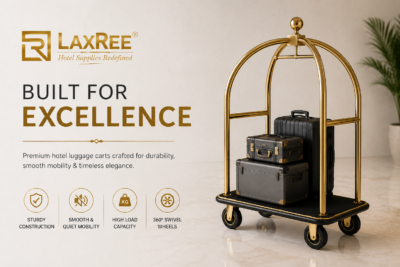 ntroduction: The First Object a Guest’s Belongings Touch
Before a guest sees their room, before they touch a single in-room amenity, before they form an opinion about the bed or the bathroom — their luggage is placed on a trolley in the lobby. That trolley is, quite literally, the first piece of hotel equipment to make physical contact with a guest’s belongings.
It also happens to be one of the most heavily used pieces of equipment on the property. A 100-room hotel with reasonable turnover might wheel a luggage trolley across its lobby floor 30–60 times a day — every check-in, every check-out, every group arrival, every bell desk request. Over a year, that is 10,000–20,000+ trips across marble, tile, carpet transitions, lift thresholds, and outdoor ramps, carrying loads that range from a single soft bag to four hard-shell suitcases stacked precariously by a guest in a hurry.
Most hotel owners specify luggage trolleys the way they specify a wastebasket — pick something that looks acceptable in a catalogue photo, order the cheapest version that meets the visual brief, and move on. The result, in a large number of Indian properties, is a trolley that looked fine on delivery day and within 12 months has a wobbling wheel, a cracked weld at the frame joint, a corroding handle, and a base plate that no longer sits flat.
This guide takes a procurement-engineering approach to the hotel luggage trolley — covering the material specifications, structural construction, wheel engineering, and load capacity considerations that determine whether a trolley survives 8–10 years of daily lobby use or needs replacement within 18 months. It also covers how to structure a B2B bulk procurement for multi-property or large-property orders.
Part 1: Why the Hotel Luggage Trolley Is a Structural Engineering Product, Not a Furniture Item
It is useful to start by reframing what a luggage trolley actually is. Visually, it sits in the “lobby furniture and amenities” category — alongside sofas, dustbins, and signage. Functionally, it is closer to a piece of material-handling equipment — the same category as a warehouse hand truck or a hospital gurney.
This distinction matters because the failure modes of a luggage trolley are mechanical, not cosmetic. A sofa that looks worn is a cosmetic problem. A luggage trolley with a failing weld, a seized wheel bearing, or a bent frame is a mechanical failure that creates an operational disruption — a bellman cannot move a guest’s bags, a trolley needs to be pulled from service mid-shift, and in the worst case, a structural failure under load creates a safety incident with guest property or, more seriously, with staff.
Specifying a luggage trolley correctly means evaluating it the way you would evaluate any piece of equipment that will bear repeated mechanical load: material grade, joint construction, load rating, and component durability — not just finish and appearance.
Part 2: Frame Material — Stainless Steel Grades and What They Mean for Hotel Trolleys
The vast majority of quality hotel luggage trolleys use stainless steel frame construction — for good reason: it combines structural strength, corrosion resistance, and a premium appearance that suits hotel lobby environments. But “stainless steel” is not a single specification — the grade matters enormously.
304 Grade Stainless Steel: The Hotel Standard
304 grade (also called 18/8 — 18% chromium, 8% nickel content) is the most widely used stainless steel grade for hotel equipment, food service equipment, and architectural fittings. It offers:
- Excellent corrosion resistance — critical for trolleys that get wet from rain-soaked luggage, spilled drinks during transport, and regular wet-mopping of lobby floors
- Good weldability — frame joints can be welded cleanly without compromising the material’s corrosion resistance at the weld point
- A bright, premium finish (in polished or brushed variants) that suits hotel lobby aesthetics
- Reasonable cost relative to higher grades
304 grade is the minimum specification any hotel should accept for a luggage trolley frame.
201 Grade Stainless Steel: The Specification to Watch For
201 grade stainless steel is a lower-cost alternative that looks visually similar to 304 grade when new — same bright finish, same general appearance in a catalogue photograph or even in person on delivery day. The difference becomes apparent over time.
201 grade has a lower nickel content (sometimes substituted with manganese), which results in:
- Significantly reduced corrosion resistance — particularly at weld points and in humid environments. 201 grade trolleys in coastal properties, monsoon-climate cities, or properties near swimming pools commonly show rust spots at weld joints within 12–18 months
- Reduced structural strength at equivalent material thickness — meaning a 201 grade frame needs to be thicker to match the strength of a 304 grade frame at a given gauge, or it will flex and fatigue faster under repeated loading
- A finish that can dull and develop a yellowish tint over time, particularly with exposure to certain cleaning chemicals
The procurement problem: 201 grade and 304 grade stainless steel cannot be reliably distinguished by visual inspection alone. A supplier quoting a significantly lower price than competitors for an apparently identical trolley design is very likely specifying 201 grade — and may not volunteer this information unless directly asked.
What to ask your supplier: Request the steel grade in writing, as part of the product specification sheet. For any bulk order, request a magnet test demonstration if uncertain (304 grade is generally non-magnetic or only weakly magnetic; 201 grade often shows stronger magnetic response) — though this is an indicative test, not a definitive one, and a written material certificate from the supplier is the correct documentation to request for B2B procurement.
Tube Gauge (Wall Thickness): The Specification That Determines Frame Rigidity
Beyond the steel grade, the wall thickness of the tubular steel used in the frame determines how much the trolley flexes under load — and how it ages under repeated flexing (a phenomenon called fatigue, which leads to cracking at stress points, typically at welds, over time).
For hotel luggage trolley main frame tubing:
- Minimum acceptable: 1.2mm wall thickness
- Recommended for heavy-duty / high-turnover properties: 1.5mm–2.0mm wall thickness
A frame built from thinner tubing (below 1.2mm) will feel adequately rigid when new and lightly loaded, but will develop a perceptible flex when loaded with 3–4 large suitcases — and that flex, repeated thousands of times, is what eventually causes weld fatigue cracking.
Part 3: Weld Quality and Joint Construction — The Failure Point Nobody Inspects
If a hotel luggage trolley fails within its first few years of service, the failure almost always occurs at a weld joint — the point where two pieces of the frame are joined. Weld quality is therefore one of the most important — and most overlooked — specifications in trolley procurement.
What a Quality Weld Looks Like
Continuous, even welds: A quality weld runs continuously along the joint, with consistent width and depth. Gaps, inconsistent bead width, or visible porosity (small holes) in the weld indicate inconsistent welding process control.
Ground and polished weld points: On a premium trolley, weld points on visible surfaces are ground smooth and polished to match the surrounding finish — there should be no sharp edges, no visible weld spatter, and no colour difference between the weld area and the surrounding steel (a colour difference, particularly a darkened or discoloured weld zone, can indicate heat damage during welding that has compromised the steel’s corrosion resistance at that point — this is a particular risk with 201 grade steel).
No visible gap-filling or putty: Some lower-quality manufacturing uses filler material to disguise poor-fitting joints before painting or polishing. This is invisible on a new product and becomes visible (as cracking or separation at the joint) within months of use.
Joint Locations to Inspect on Any Sample
When evaluating a sample trolley before bulk order, physically inspect these joint locations — they are the highest-stress points on any luggage trolley frame:
- Where the vertical frame uprights meet the base platform
- Where the handle assembly meets the frame uprights
- Where the wheel axle brackets meet the base frame
- Any joint where a shelf or secondary platform attaches to the main frame
Apply firm hand pressure at each of these joints — push, pull, and twist gently. Any perceptible movement, creaking sound, or flex at a joint on a brand-new sample is a strong indicator of inadequate weld penetration, and the design should be rejected for bulk order regardless of price.
Part 4: Wheel Engineering — The Component That Determines Daily Usability
Wheels are the most mechanically active component of a luggage trolley — they are in continuous motion every time the trolley is used, and they bear the trolley’s full loaded weight at every point of contact with the floor. Wheel specification has an outsized impact on both guest perception (a trolley that rolls smoothly and silently feels premium; one that squeaks or judders feels cheap) and operational durability.
Wheel Material
Solid rubber wheels: The standard for hotel luggage trolleys. Solid rubber provides good shock absorption (protecting both the trolley frame and the guest’s luggage from vibration on uneven floor surfaces), good grip on polished marble and tile (a significant safety consideration — trolleys on smooth lobby floors with low-grip wheels can slip, particularly when fully loaded and being manoeuvred around corners), and quiet operation.
Polyurethane (PU) wheels: A premium alternative to solid rubber — PU wheels offer similar grip and shock absorption characteristics with generally longer wear life and better resistance to degradation from cleaning chemicals commonly used on lobby floors. PU wheels are increasingly the specification of choice for premium hotel trolleys.
Hard plastic / nylon wheels: The lowest-cost option, found on budget trolleys. These wheels transmit vibration directly to the frame and luggage (uncomfortable for guests watching their bags being transported, and damaging to delicate luggage over repeated trips), generate significantly more noise on hard floors (an audible issue in a quiet hotel lobby), and can mark or scuff polished floor surfaces — an aesthetic problem for properties with premium marble or stone lobby flooring.
Wheel Bearing Quality
The bearing inside each wheel — the component that allows the wheel to rotate smoothly around its axle — is rarely specified explicitly in product catalogues, but is the component most responsible for how a trolley “feels” after a year of use.
Sealed ball bearings: The correct specification for hotel luggage trolleys. Sealed bearings keep out dust, lint, and moisture (all present in a hotel lobby environment), maintaining smooth rotation over years of use without requiring maintenance.
Open or unsealed bearings / simple bushings: Lower-cost alternatives that allow dust and moisture ingress. Over months of use, contamination inside the bearing causes increased rolling resistance — the trolley becomes progressively harder to push, and eventually the wheel can begin to wobble or seize entirely. This is the most common reason a luggage trolley that “rolled beautifully” on delivery day becomes difficult and noisy to manoeuvre within a year.
What to ask your supplier: Confirm bearing type for the wheel specification. For B2B bulk orders, request the wheel manufacturer’s specification sheet — quality trolley manufacturers source wheels from established wheel/castor manufacturers and can provide this documentation; manufacturers using unbranded generic wheels typically cannot.
Wheel Configuration: 4-Wheel vs Multi-Wheel Designs
Standard 4-wheel configuration: The most common design — four wheels at the base corners, with the front (or all) wheels swivel-mounted for manoeuvrability. Adequate for most hotel applications.
360-degree swivel on all wheels: Allows the trolley to be turned in place without forward/backward movement — particularly valuable in tight lobby spaces, around reception desk corners, and in lift lobbies. This is a significant usability feature that staff notice immediately in daily use, even if guests do not consciously register it.
Locking/braking wheels: For trolleys that will be loaded at a fixed point (e.g., at the bell desk while bags are being organised) and then moved, at least one wheel with a locking brake prevents the trolley from rolling away during loading — a practical safety and convenience feature, particularly on lobby floors that are not perfectly level.
Wheel Diameter and Floor Surface Transitions
Hotel lobbies frequently feature floor transitions — from marble or tile in the main lobby to carpet in corridors, and thresholds at lift doors and entrance doors. Wheel diameter affects how smoothly a loaded trolley navigates these transitions.
Minimum recommended wheel diameter for hotel luggage trolleys: 75mm (3 inches). Smaller wheels can catch on carpet edges, door thresholds, and minor floor irregularities — requiring the bellman to apply extra force at exactly the moments (in front of arriving or departing guests) when smooth operation matters most.
Part 5: Load Capacity — Specifying for Real-World Guest Luggage
Load capacity specifications in trolley catalogues are sometimes a theoretical maximum under controlled conditions, rather than a sustainable operational capacity. Understanding the difference matters for procurement.
Real-World Luggage Weight Reference
To specify load capacity sensibly, it helps to know what hotel luggage trolleys actually carry:
- Standard checked suitcase (medium, packed): 15–23 kg
- Large checked suitcase (packed): 23–32 kg
- A group booking arrival: 4–6 large suitcases plus carry-on bags and miscellaneous items on a single trolley is common practice, even when not strictly recommended by hotel policy
Realistic peak load for a single trolley in active use: 100–150 kg, accounting for multiple large suitcases plus miscellaneous items, as guests and bell staff will load trolleys to capacity during busy check-in periods regardless of posted guidance.
Specification vs Sustainable Operating Load
A trolley specified with a “maximum load capacity” of 150kg should be understood as the absolute limit under ideal conditions — flat floor, careful loading, brief duration. For sustained daily operation across years of use, specifying a trolley with a stated maximum capacity meaningfully above your expected real-world peak load (a safety margin of 30–50% above expected peak load is a reasonable target) ensures the trolley is operating well within its structural limits during normal use — which directly extends frame and weld life.
Practical guidance: For a property regularly handling group bookings and multi-bag arrivals, specify trolleys with a stated maximum load capacity of at least 200kg, even though typical individual loads may be well below this figure. The margin protects the structural components from cumulative fatigue.
Part 6: Platform Design and Guest-Facing Considerations
Platform Surface
Slatted platform (open slats): Common, allows debris and water to fall through rather than accumulating on the platform surface — practical for properties in monsoon climates where guests arrive with wet luggage.
Solid platform with raised edge lip: Prevents smaller items (bags, umbrellas, loose items) from sliding off during transport, particularly when the trolley is being manoeuvred around corners or up ramps. A raised edge of at least 25mm on all sides of the platform is a meaningful practical feature.
Handle Height and Ergonomics
Handle height affects both guest-facing aesthetics (a trolley with a handle that is too tall looks oversized and institutional; too short, and staff must stoop) and staff ergonomics (repetitive use of a poorly positioned handle over a full shift contributes to staff fatigue and, over years, repetitive strain).
Recommended handle height range: 90–105cm from floor level — comfortable for the average adult height range of hotel bell staff in India, allowing a natural pushing posture without excessive stooping or reaching.
Branding Integration
Many premium hotel luggage trolleys include a designated panel or plate for hotel branding — typically on the handle crossbar or a front-facing panel. For properties investing in lobby brand consistency, confirm whether the trolley design accommodates custom branding (engraved plate, printed panel, or vinyl application area) and whether this is included in the base specification or an additional customisation.
Part 7: Finish and Maintenance — What “Premium Appearance” Costs Over Time
Polished vs Brushed (Satin) Finish
Mirror-polished stainless steel: The most visually striking finish — high-gloss, reflective surface that photographs well and creates a strong premium first impression. The maintenance consideration: a mirror finish shows fingerprints, water spots, and minor scratches far more visibly than a brushed finish. In a high-touch item like a luggage trolley — handled by staff and occasionally guests dozens of times daily — a mirror finish requires more frequent cleaning to maintain its appearance.
Brushed (satin) stainless steel: A textured, matte-sheen finish that hides fingerprints, minor scratches, and water spots significantly better than a polished finish, while still presenting as a premium material. For high-traffic lobby equipment, brushed finish is often the more practical specification — maintaining a “well-kept” appearance with less intensive cleaning effort, compared to a polished finish that can look “dirty” (from visible fingerprints and smudges) even shortly after cleaning.
Procurement consideration: Match the finish specification to your housekeeping team’s realistic cleaning frequency for lobby equipment. A property with dedicated lobby attendants who polish brass and steel fixtures multiple times daily can sustain a mirror finish. A property where lobby equipment cleaning is part of a broader housekeeping rotation may find brushed finish maintains a better day-to-day appearance with realistic cleaning frequency.
Part 8: B2B Bulk Procurement — Sourcing Hotel Luggage Trolleys at Scale
Calculating Your Trolley Requirement
Unlike in-room amenities (where quantity scales directly with room count), luggage trolley quantity scales with lobby operations and peak arrival patterns — not room count.
General guidance:
- Properties up to 50 rooms: 2 trolleys (1 primary, 1 backup/secondary use)
- Properties 50–150 rooms: 3–4 trolleys
- Properties 150+ rooms or properties with significant group/conference business: 4–6 trolleys, with additional units for peak group check-in/check-out periods
Additional considerations: Properties with multiple entry points (e.g., a separate banquet/conference entrance from the main guest entrance) may require dedicated trolleys at each entry point. Properties with consistent group business should specify additional trolleys specifically for peak-period deployment — having trolleys “in reserve” for a 50-person group arrival prevents the operational bottleneck of bell staff waiting for trolleys to free up.
Volume Pricing for Multi-Property Procurement
For hotel groups managing multiple properties, luggage trolleys represent a smaller per-unit order quantity than in-room amenities (typically single-digit to low-double-digit quantities per property) — but consolidating orders across multiple properties into a single B2B procurement achieves meaningful volume pricing that property-by-property ordering does not.
Example: A hotel group with 8 properties, each requiring 3 trolleys, represents a 24-unit order when consolidated — crossing volume pricing thresholds that an individual property’s 3-unit order would not reach on its own.
Sample Testing Protocol Before Bulk Order
Given that frame and weld quality issues are not visible on delivery day and only become apparent after months of use, sample testing before bulk ordering is particularly important for luggage trolleys.
Recommended sample evaluation process:
Visual and physical inspection: Inspect all weld joints as described in Part 3. Check for any gaps, inconsistent welds, or visible filler material.
Load test: Load the sample trolley to its stated maximum capacity (or to your realistic peak load specification) using actual luggage or equivalent weighted items. Observe the frame for any visible flex, and listen for any creaking at joints.
Rolling test on multiple surfaces: Push the loaded trolley across the actual floor surfaces it will operate on — marble, tile, carpet, any threshold transitions at lift doors or entrances. Assess rolling resistance, noise level, and ease of directional control (particularly turning corners with a full load).
Extended trial period: For larger orders (4+ units), consider placing a single-unit trial order and operating it in actual hotel service for 30–60 days before confirming the full bulk order. This reveals real-world wear patterns — wheel bearing performance, weld fatigue under actual (not simulated) load cycles, and finish durability under your property’s actual cleaning regime — that cannot be assessed in a short sample evaluation.
Warranty Terms for Luggage Trolleys
Frame structural warranty: Given that frame and weld failures are the primary failure mode and often develop over 12–24 months of use, request a structural warranty of at least 24 months on frame welds and joints — covering cracking, separation, or structural failure under normal operational load.
Wheel and bearing warranty: 12 months minimum on wheel assemblies, covering bearing seizure, wheel degradation, or wobble developing under normal use.
Finish warranty: 12 months on finish — covering premature corrosion (particularly relevant if 304 grade steel was specified — any corrosion within the warranty period on a 304 grade product indicates either a material specification issue or a weld-point quality issue, both of which should be covered).
Part 9: The LaxRee Luggage Trolley Range — LRLT 401 and Beyond
LaxRee Amenities supplies hotel luggage trolleys engineered for the demands of Indian hotel lobby operations — including the LRLT 401 Luggage Hand Trolley, featuring a stainless steel body construction with heavy-duty four-wheel design for smooth, silent operation across the varied floor surfaces found in Indian hotel lobbies — from polished marble to carpeted corridors to outdoor entrance ramps.
For B2B procurement, LaxRee provides:
- Material specification documentation — steel grade, tube gauge, and wheel bearing specifications confirmed in writing
- Physical samples available for load testing and rolling evaluation before bulk order confirmation
- Volume pricing for multi-unit and multi-property orders
- Custom branding options for properties seeking logo integration on trolley handle panels
- Structural warranty terms covering frame, weld, and wheel components
- Combined procurement alongside other lobby amenities — housekeeping and linen trolleys, lobby dustbins, and the complete lobby amenities range — for coordinated lobby equipment specification
Explore the LaxRee luggage trolley range at laxree.com/product-category/amenities/lobby-amenities/luggage-trolley or contact our B2B procurement team for a specification consultation matched to your property’s lobby operations and peak arrival patterns.
The Hotel Luggage Trolley Procurement Checklist
Material Specification:
- Steel grade confirmed in writing (304 grade minimum)
- Tube wall thickness confirmed (1.2mm minimum; 1.5mm+ for heavy-duty)
- Finish type confirmed (polished vs brushed) and matched to housekeeping capacity
Structural Quality:
- All weld joints inspected on physical sample for continuity, consistency, and absence of discolouration
- Joint flex test performed at all major stress points
- Load test performed at stated maximum capacity using real or equivalent weighted luggage
Wheel Specification:
- Wheel material confirmed (solid rubber or PU recommended)
- Bearing type confirmed (sealed ball bearings recommended)
- Wheel diameter confirmed (75mm/3 inch minimum)
- Swivel and/or locking wheel configuration confirmed and tested
- Rolling test completed across all relevant floor surface transitions
Platform and Ergonomics:
- Platform design (slatted vs solid with lip) matched to property climate and guest profile
- Handle height confirmed within ergonomic range (90–105cm)
- Branding integration option evaluated if required
Procurement:
- Quantity calculated based on lobby operations and peak arrival patterns (not room count)
- Volume pricing confirmed, including multi-property consolidation if applicable
- Frame/weld structural warranty confirmed (24 months minimum)
- Wheel/bearing warranty confirmed (12 months minimum)
- Extended trial period considered for larger orders
Conclusion: The Trolley That Outlasts Its Replacement Cycle
A hotel luggage trolley specified correctly — quality stainless steel grade, properly welded joints, sealed bearing wheels, and a load capacity with genuine safety margin — will operate in daily lobby service for 8–10 years with nothing more than routine cleaning.
A trolley specified on price alone, with unverified steel grade and unconfirmed weld quality, will look identical on delivery day — and will require replacement, mid-operation troubleshooting, and the operational disruption of bell staff working around a “trolley that’s not working right” within 18–24 months.
The visible difference between these two outcomes — to a guest watching their luggage being wheeled across the lobby — is zero on day one. The operational and financial difference, over the equipment’s working life, is substantial. Specify accordingly.


