
Introduction: The Kettle on Your Hotel Room Desk Is a Procurement Decision Worth Getting Right
Every hotel room in India above budget category has an electric kettle. It is the most universally used in-room appliance — used by business travellers before a 7am meeting, by leisure guests during a late-night rainstorm, by families making milk for infants, by every guest who wants anything hot without picking up the phone and waiting for room service.
It is also, in most Indian hotels, one of the most poorly specified in-room appliances. Not because hotel owners do not care — but because the kettle purchase decision is typically made on price, and the technical specifications that determine whether a kettle performs reliably for 4 years or needs replacement in 14 months are rarely evaluated.
This guide is written for hotel purchase managers, GMs, and procurement teams who want to specify and buy hotel kettles correctly — understanding the technical differences between commercial and household units, knowing exactly which specifications matter for hotel use, and knowing how to structure a bulk procurement that delivers consistent quality at volume pricing.
Part 1: Commercial Hotel Kettle vs Household Kettle — Why They Are Not the Same Product
The most consequential procurement mistake in hotel kettle buying is purchasing household kettles for hotel use. They look identical. They often carry the same brand names. They are significantly cheaper. And they fail significantly faster under hotel operating conditions.
Here is exactly why they are different:
Usage Frequency — The Core Difference
A household kettle is used by one family, typically 1–3 times per day, by people who know how to use it and maintain it.
A hotel kettle is used by a different person every 1–3 nights, often multiple times per day, by guests who may misuse it (boiling with no water, overfilling, using it for purposes other than boiling water), and who will never descale it, never read the manual, and never notice if it is developing a fault until it stops working entirely.
This usage pattern — high frequency, multiple users, zero maintenance — is what commercial hotel kettles are engineered for. Household kettles are not.
Heating Element Construction
Household kettles: Many use an exposed coil heating element — a metal coil visible at the bottom of the kettle interior. These are cheaper to manufacture and perfectly adequate for careful home use.
Commercial hotel kettles: Use a fully concealed stainless steel disc element — the heating surface is a flat, sealed disc at the base of the kettle interior. No visible coil, no exposed metal, completely smooth base.
Why this matters in hotels:
Scale accumulation: In hard water areas (most of Rajasthan, Delhi, Gujarat, and large parts of Maharashtra and UP), scale deposits form quickly on heating elements. On an exposed coil, scale builds around the wires — eventually insulating the element, causing overheating and burnout. On a concealed disc, scale forms on a flat surface and can be wiped clean. The concealed disc element lasts significantly longer in Indian hard water conditions.
Hygiene perception: When a guest looks into the kettle before use — and many do — a scaled, exposed coil looks dirty even when clean. A smooth concealed disc looks hygienic regardless of minor scale. This directly affects guest perception and reviews.
Safety: A cracked or damaged exposed coil creates a live electrical wire in contact with water. A concealed disc element has no exposed electrical components in contact with water even if the surface is scratched.
Auto Shut-Off and Boil-Dry Protection
Both features are standard on household kettles — but the quality of implementation matters significantly in hotel use.
Auto shut-off: The steam sensor that triggers shut-off must be calibrated correctly. Household kettles are calibrated for controlled indoor environments. Commercial hotel kettles are calibrated to function correctly across the range of ambient conditions in Indian hotel rooms — from a 16°C AC room in December to a 32°C room in May before the AC has cooled it down.
A steam sensor that misfires at high ambient temperature — shutting off before full boil — generates guest complaints (“the kettle doesn’t boil properly”). A sensor calibrated for commercial use does not.
Boil-dry protection: In hotels, guests occasionally switch the kettle on without water — by mistake, by testing, or because they forgot to fill it. Without boil-dry protection, this burns out the heating element within seconds and destroys the kettle. With it, the kettle cuts power instantly when no water is detected, protecting the element.
In a household, this happens rarely. In a hotel with 100 rooms and hundreds of different guests per month, it happens frequently. Boil-dry protection is not a feature — it is a commercial necessity.
Body Material and Finish Durability
Household kettles: Frequently use ABS plastic bodies or thin-gauge stainless steel. ABS plastic is light, inexpensive, and adequate for careful home use where the kettle sits in one place and is handled gently.
In hotels: ABS plastic bodies discolour within 6–12 months of commercial housekeeping cleaning (cleaning chemicals react with the plastic surface). They scratch easily, develop a cloudy appearance, and begin to look institutional and cheap. Thin stainless steel dents under the handling of multiple housekeeping rotations per week.
Commercial hotel kettles: Use food-grade 304 stainless steel at a minimum gauge of 0.4mm. This grade resists both discolouration from cleaning chemicals and minor impact dents from everyday handling. The brushed or mirror finish maintains its appearance through hundreds of housekeeping cycles.
Why 304 grade specifically: 304 stainless steel (also called 18/8 steel — 18% chromium, 8% nickel) is the food contact standard used across commercial food service equipment globally. It is corrosion-resistant, does not leach metals into boiling water, and does not react with the acids naturally present in water. Lower grades of stainless steel corrode at the weld points and in areas of repeated moisture exposure — which is the base of the kettle, every time it sits on a wet counter.
Part 2: The Technical Specifications That Matter — A Complete Evaluation Framework
When evaluating hotel kettles for procurement, these are the specifications to request from every supplier and evaluate before placing a bulk order.
Wattage: Speed Is a Guest Experience Factor
The wattage of a hotel kettle determines how fast it boils. This is not a trivial detail — a slow-boiling kettle in a hotel room is a consistent guest frustration that appears in reviews.
Wattage guide for Indian market (230V supply):
| Wattage | Boil time (1 litre) | Suitability |
|---|---|---|
| 1,000W | ~5–6 minutes | Not suitable for hotels |
| 1,500W | ~3–4 minutes | Budget hotels only |
| 1,800W | ~2–2.5 minutes | Minimum for 3-star properties |
| 2,000W | ~1.5–2 minutes | Recommended for 3-star to 4-star |
| 2,200W–2,400W | ~90 seconds | Premium, 4-star to 5-star |
Important caveat for Indian electrical supply: India’s electrical grid delivers 230V at 50Hz — but voltage fluctuates, particularly in Tier 2 and Tier 3 cities and in older hotel buildings. Specify kettles with a voltage tolerance of ±10% (meaning the kettle operates correctly between 207V and 253V). A kettle specified only for 230V exact may perform poorly or trip its safety switch during voltage fluctuations.
Capacity: Match to Room Occupancy
0.8 litre: Suitable for single occupancy rooms and budget properties. Holds enough for 2 cups of tea or coffee. Low profile works well in compact room setups.
1.0 litre: The standard recommendation for most Indian hotel rooms — adequate for double occupancy (2 guests making hot drinks simultaneously) without being oversized for the tray presentation.
1.2–1.5 litre: Suite categories and family rooms. Allows multiple beverages to be prepared in one boil cycle — relevant for suites where guests may be entertaining in the room.
Procurement note: Do not mix capacities randomly across room categories to save cost. Define the capacity per room category and maintain it consistently. Mixed capacity kettles in adjacent rooms generate guest complaints about inconsistency.
Safety Certifications: What Is Mandatory in India
For hotel procurement in India, electrical appliances must carry specific safety certifications. This is not optional — uncertified appliances expose the hotel to liability in the event of an electrical incident.
BIS (Bureau of Indian Standards) certification: The IS 302-2-15 standard covers electric kettles in India. BIS certification confirms the kettle meets Indian safety standards for electrical insulation, overheating protection, and earthing. Any supplier unable to provide BIS certification documentation for their hotel kettle should be disqualified from the procurement.
ISI Mark: The ISI mark (Indian Standards Institution) is the visible certification mark on BIS-certified products. Confirm the ISI mark is present on the physical product, not just claimed in the product catalogue.
CE Marking (for imported products): European Conformity marking indicates compliance with EU safety standards. While not a substitute for BIS certification in India, CE marking on an imported kettle indicates the product has passed rigorous safety testing and is appropriate for commercial use.
RoHS Compliance: Restriction of Hazardous Substances — relevant for products containing electronic components. Confirms the kettle does not contain hazardous materials including lead, mercury, or cadmium in its electronics.
Cord and Base Specifications
360° cordless base: Non-negotiable for hotels. The kettle must lift from its base in any direction — no directional cord attachment. Guests should never need to orient the kettle to a specific direction to lift it cleanly.
Cord length: Minimum 0.75 metre from base to wall plug. In many Indian hotel room configurations, the nearest socket to the desk or tray position is not directly adjacent — a short cord forces a difficult reach or an awkward placement of the entire kettle setup.
Cord storage: A base with integrated cord storage — where excess cord wraps around the base — keeps the desk area tidy and eliminates trailing cord hazards. This is a housekeeping efficiency feature as well as an aesthetic one.
Earthing: All commercial hotel kettles must be earthed (3-pin plug with functional earth connection). Confirm this explicitly — some lower-cost models are supplied with a 2-pin plug that eliminates the earth connection. In a hotel setting with guests of all ages and varying electrical awareness, earthing is a non-negotiable safety requirement.
Lid and Filling Design
Wide-mouth opening: The lid and filling opening should be wide enough for easy water filling from a bathroom tap — minimum 6cm diameter. Narrow openings result in slow, messy filling and are a consistent minor frustration.
Lid attachment: The lid should be firmly attached when the kettle is tilting to pour — not loose enough to fall off mid-pour. A lid that detaches during pouring causes spills and burns risk. Test this physically before approving a bulk order.
Water level window: A clearly visible water level indicator on the exterior of the kettle — showing minimum and maximum fill lines — prevents both under-filling (inadequate water for boiling) and over-filling (spitting and boil-over). The indicator should be visible from the typical standing position when filling at a bathroom tap — not only from directly below.
Handle Design and Heat Safety
The handle is the single most-touched part of the kettle. In a hotel context, it must be:
Heat-insulated: The handle should remain cool to touch throughout and after boiling. An ABS or soft-grip rubberised handle meets this requirement. A metal handle that conducts heat from the body is a burn risk.
Ergonomic grip for one-handed pouring: The centre of gravity when the kettle is full and lifting for pour should be manageable with one hand for adults of average strength. Test this with a full kettle. Heavy or awkwardly balanced kettles result in spills and burns.
Minimum grip width: At least 4cm of clear grip space inside the handle — narrower handles cannot be gripped by guests with larger hands, generating frustration.
Part 3: The Hotel Kettle Set — Specifying the Complete Presentation
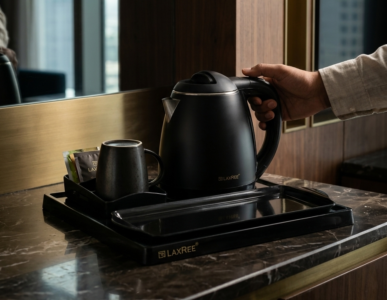
The kettle is never presented alone in a hotel room. It is part of a set — the kettle, its base, the tray it sits on, and the sachet arrangement beside it. Specifying the set correctly is as important as specifying the kettle itself.
Tray Specification
The tray is the visual foundation of the entire in-room beverage setup. It determines whether the desk area looks premium or assembled.
Material options:
Lacquer tray (MDF or wood base): The most popular choice for Indian hotels from 3-star upwards. Available in matte or gloss finish in black, white, ivory, and dark wood tones. Wipe-clean surface. Works well with both stainless steel and plastic-body kettles. Affordable and widely available.
Solid wood tray: Natural teak, sheesham, or rubberwood. Warm, premium aesthetic. Best for boutique hotels, resort properties, and heritage hotels where natural materials align with the brand. Requires occasional oiling to prevent drying and cracking in AC environments.
Metal tray (brushed stainless or chrome): Very durable, very easy to clean, modern aesthetic. Works particularly well in contemporary business hotels and properties with a minimal design language.
Tray sizing guide:
The tray must comfortably hold the kettle, 2 cups or mugs, a small sachet organiser or tray, and 2 spoons — without overcrowding. A tray that requires precise arrangement every service is a housekeeping inefficiency. Recommended minimum dimensions:
- Standard rooms: 35cm × 25cm
- Superior/Deluxe rooms: 40cm × 28cm
- Suites: 45cm × 30cm or custom
Cup and Mug Specification
Hotel cups vs standard mugs:
Standard ceramic mugs are common in Indian hotel rooms but are heavy, chip easily on hard tray surfaces, and look generic across any room category.
Bone china cups: Lighter, more elegant, appropriate for 4-star and above. Higher breakage replacement cost but significantly better guest perception.
Branded cups: Custom logo or monogram on the cup is a brand touchpoint that guests notice and often photograph. The investment in branded cups pays back in social media content value — guests sharing photographs of the in-room setup organically publish the hotel brand.
Number of cups per room: 2 cups minimum for all double-occupancy rooms. 4 cups for suites and family rooms.
Sachet Organiser
The arrangement of tea, coffee, sugar, and creamer sachets beside the kettle is a direct reflection of how much care the hotel takes with presentation details.
Loose sachets in a pile: Looks rushed and careless. Sachet packets become crumpled and mixed after the first guest handles them.
Sachet tray or organiser: A small divided tray or box that holds each sachet type in its own compartment. Every housekeeping service restores the organiser to the same configuration. The result is a consistently tidy, organised presentation that photographs well and communicates care.
Sachet selection guidance by property category:
| Category | Tea | Coffee | Additional |
|---|---|---|---|
| Budget (2–3 star) | 2 tea bags (standard) | 1 instant coffee sachet | Sugar, creamer |
| Midscale (3–4 star) | 2–3 tea bags (2 varieties) | 2 instant coffee sachets | Sugar, raw sugar, creamer, honey sachet |
| Premium (4–5 star) | 3–4 tea bags (3+ varieties incl. green tea) | 2 varieties (instant + filter/pod if applicable) | Full accompaniment + local specialty tea |
Part 4: Bulk Procurement — How to Buy Hotel Kettles at Scale
For any hotel above 20 rooms, kettle procurement should be treated as a B2B bulk purchase — not a product-by-product retail transaction. The difference in unit cost, consistency, and supply relationship quality is substantial.
Calculating Your Total Kettle Requirement
Base quantity: 1 kettle per room = your room count.
Buffer stock (10–15%): Hotels should maintain a buffer of 10–15% above room count to cover units in maintenance, units damaged beyond repair, and the replacement cycle lag between identifying a failed unit and receiving a replacement. For a 60-room hotel: 60 + 9 buffer = 69 kettles to order.
Tray and accessory quantity: Tray sets, cups, and sachet organisers follow the same formula — 1 per room plus 10–15% buffer. Order these with the kettle in a single purchase to ensure design consistency and avoid future mismatch.
Volume Pricing Thresholds — What to Expect
When ordering direct from a B2B hospitality supplier, volume pricing typically activates at the following thresholds:
| Order Quantity | Expected Discount vs Single Unit |
|---|---|
| 10–20 units | 8–12% |
| 21–50 units | 15–20% |
| 51–100 units | 22–28% |
| 100+ units | 28–35%+ (negotiable) |
For a 60-room hotel ordering 69 kettles plus tray sets and accessories, the savings from B2B volume pricing versus retail purchasing typically amount to ₹40,000–₹90,000 on the total order — depending on the product range and supplier relationship.
Sample Testing Before Bulk Order — Non-Negotiable
Never place a bulk order for hotel kettles based on a catalogue photograph and a price. Request physical samples of every model under consideration before confirming the order.
Sample testing protocol:
Day 1: Unbox and inspect — finish quality, cord quality, lid operation, handle feel, water level indicator clarity.
Day 1–3: Boil 10 times per day — assess boil speed, steam output, auto shut-off consistency, noise level. Note any variation between boils.
Day 4: Descale simulation — use a mild citric acid solution to descale. Assess how easily scale is removed and whether the interior surface shows any damage.
Day 5: Boil-dry test — operate the kettle without water. Confirm boil-dry protection activates within 3 seconds.
Day 5: Drop test — hold at counter height and allow to fall on a hard floor surface. Inspect for body damage, lid attachment, and base damage. (Hotels will drop kettles. The question is whether the product survives it.)
Only after completing this protocol should you approve a model for bulk order. A kettle that fails the sample protocol fails it at the cost of 1 unit — not 70.
Warranty and After-Sales Specification
For bulk procurement of hotel kettles, warranty terms should be specified in the purchase agreement — not assumed from the product box.
Minimum acceptable warranty:
- Heating element and electrical components: 12 months commercial use warranty
- Body and handle: 12 months against manufacturing defects
- Base and cord: 12 months
What the warranty should cover:
- Element burnout
- Auto shut-off failure
- Boil-dry protection failure
- Body seam separation
What to confirm before ordering:
- Is the warranty valid for commercial hotel use, or residential use only? Many consumer warranties explicitly exclude commercial applications.
- What is the replacement process? Direct courier replacement or workshop repair? In a hotel, a kettle that needs to go to a workshop for 3 weeks is effectively a dead unit — you need a replacement, not a repair.
- Does the supplier maintain replacement stock of the exact model you have ordered, for ongoing replacements?
Part 5: Total Cost of Ownership — The Correct Way to Evaluate Kettle Procurement
The single most important concept in hotel kettle procurement — and the one most often ignored — is total cost of ownership (TCO). This is the complete financial cost of a kettle purchase over its operational life, including not just the purchase price but all downstream costs.
TCO Calculation Example
Option A: Low-cost household kettle
- Unit purchase price: ₹850
- Expected commercial hotel lifespan: 14 months
- Replacements over 5 years: 3.4 units
- Total unit cost over 5 years: ₹2,890
- Housekeeping incidents (slow boil complaints, failed units): Moderate — estimate 3 incidents per unit lifespan × 3.4 = 10 incidents
- Guest review impact: 1–2 negative mentions per year related to kettle
Option B: Commercial-grade hotel kettle
- Unit purchase price: ₹1,650
- Expected commercial hotel lifespan: 4–5 years
- Replacements over 5 years: 1 unit
- Total unit cost over 5 years: ₹1,650
- Housekeeping incidents: Low — estimate 1 incident per unit lifespan
- Guest review impact: Near zero
5-year TCO comparison per room:
- Option A: ₹2,890 + operational cost of 10 incident responses
- Option B: ₹1,650 + operational cost of 1 incident response
The ₹800 per unit “saving” in Option A costs the hotel ₹1,240 per room over 5 years — before counting the operational overhead and review damage.
At 60 rooms: Option A costs ₹74,400 more than Option B over 5 years. For a product where the per-unit price difference is ₹800.
This is the mathematics of correct hotel procurement. Quality costs more upfront. It costs significantly less over the operational life of the product.
LaxRee Hotel Kettle Set: Built for Indian Commercial Hotel Use
LaxRee Amenities supplies hotel-grade electric kettle sets specifically designed for Indian commercial hotel operating conditions — the hard water conditions of Rajasthan, Delhi, and Gujarat; the voltage fluctuations of Tier 2 and Tier 3 city properties; the demanding housekeeping cycles of high-occupancy commercial hotels.
Our kettle sets are available as complete units — kettle, coordinated tray, cups, and sachet organiser — allowing hotels to specify and receive the entire in-room beverage setup from a single supplier in a single order. No mix-matching across suppliers, no design inconsistency, no coordinating separate delivery timelines.
For B2B procurement, LaxRee offers:
- Volume pricing from 20 units onwards — structured discount tiers for larger orders
- Physical samples for evaluation before bulk order confirmation
- Complete warranty documentation confirming commercial use coverage
- Ongoing replacement stock maintenance — the same model, available for replacements throughout the product’s service life
- Combined ordering with tray sets, mini bars, safe boxes, and other room accessories — single-supplier procurement for the complete room kit
Explore the LaxRee kettle set range at laxree.com/product-category/amenities/room-amenities/kettle-set or contact our B2B procurement team for a quotation matched to your property’s room count and category.
The Hotel Kettle Procurement Checklist
Before placing any bulk kettle order, confirm all of the following:
Technical Specification:
- Concealed stainless steel disc element confirmed (not exposed coil)
- Food-grade 304 stainless steel body confirmed
- Wattage confirmed — minimum 1,800W for 3-star; 2,000W+ recommended for 4-star+
- Voltage tolerance confirmed — ±10% (207V–253V operating range)
- Auto shut-off confirmed with calibration documentation
- Boil-dry protection confirmed
- 360° cordless base confirmed
- Cord length minimum 0.75m confirmed
- Earthed 3-pin plug confirmed
Safety Certification:
- BIS certification (IS 302-2-15) confirmed in writing
- ISI mark visible on physical sample
- Commercial use warranty confirmed (not residential only)
Procurement:
- Physical sample tested and approved
- Sample drop test and boil-dry test completed
- Volume pricing confirmed for full order quantity
- Buffer stock (10–15%) included in order quantity
- Tray set, cups, and sachet organiser included in same order
- Ongoing replacement stock availability confirmed
Conclusion: The Kettle Is Small. The Procurement Decision Is Not.
A hotel electric kettle costs ₹800–₹2,500 per unit. In the context of a hotel room that may have cost ₹30–₹80 lakh to build and fit out, it is a rounding error.
But multiply that unit by 60 rooms, extend it over 5 years, add the operational cost of managing failures and guest complaints, and factor in the review score impact of a product that fails guests at 6am when they need their tea — and the kettle procurement decision starts to look a lot more significant.
Specify correctly. Test before ordering. Buy commercially-rated products at volume pricing through a B2B supplier who maintains ongoing stock. That is how a ₹1,650 kettle outperforms a ₹850 one by a wide margin — and how hotel owners who understand procurement economics make better decisions than those who buy on unit price alone.


