
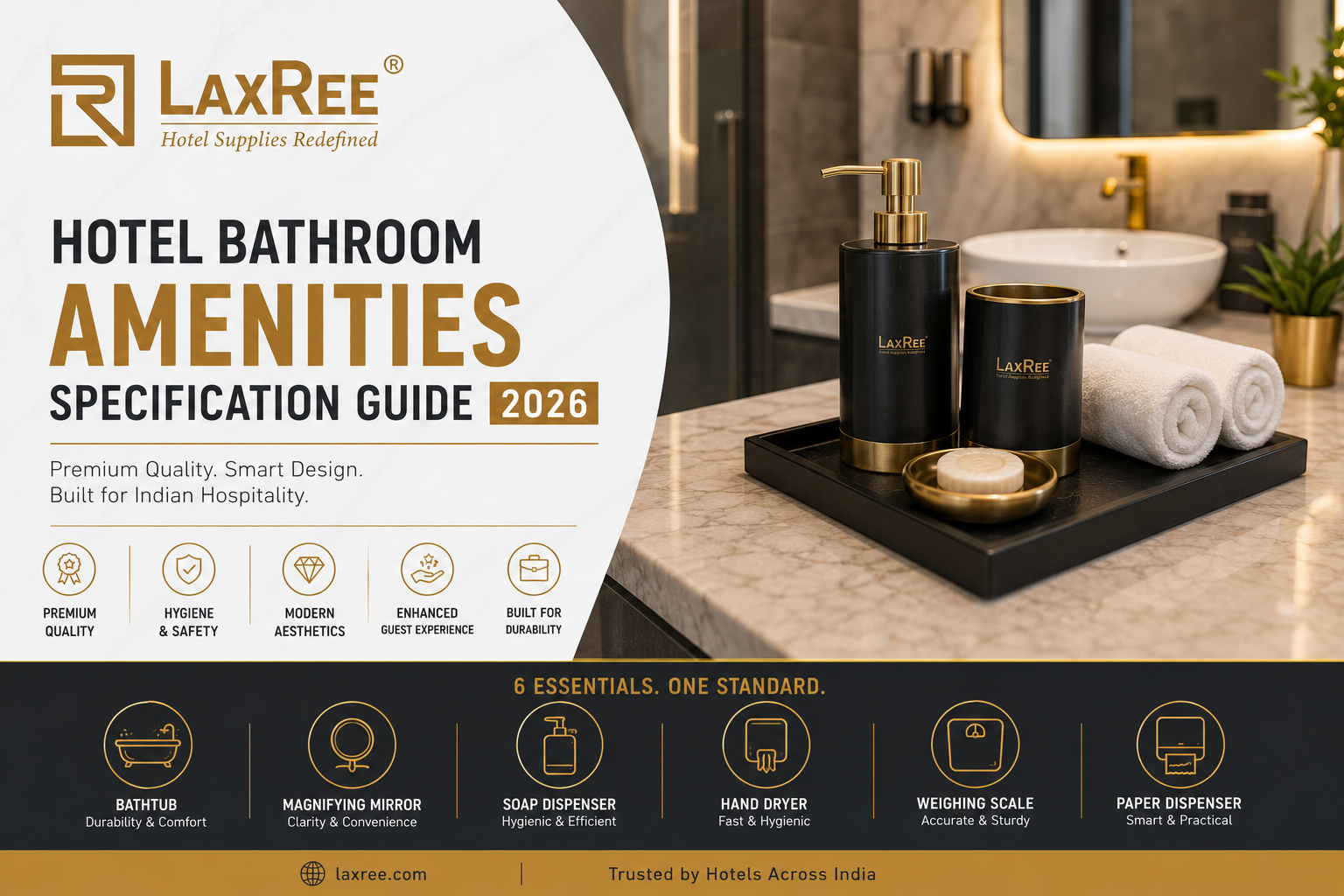
Hotel Bathroom Amenities Complete Specification Guide: Bathtub, Magnifying Mirror & Washroom Essentials for Indian Hotels 2026
The hotel bathroom is where a guest’s day begins and ends.
It is the space they use before the important meeting. The space they retreat to after a long journey. The space that, in a luxury property, promises a moment of genuine indulgence — and that, in a poorly specified property, quietly communicates that no one thought too carefully about their comfort.
The bathroom amenity decision in Indian hotel procurement is almost universally made on two criteria: appearance in a catalogue photograph and price. The technical specifications that determine whether a bathtub’s acrylic maintains its gloss for 8 years or clouds within 2 seasons, whether a magnifying mirror’s LED provides clinically accurate light or a flattering but useless amber warmth, whether a soap dispenser’s pump mechanism survives 50,000 actuation cycles before failing — these are almost never evaluated.
This guide covers the complete hotel washroom amenity ecosystem — bathtub, magnifying mirror, soap dispenser, hand dryer, paper dispenser, and the full supporting range — with the technical specifications that separate a correctly procured bathroom from one that looks right on delivery day and disappoints within two years.
Why the Bathroom Specification Gets Less Attention Than It Deserves
In most Indian hotel procurement processes, the bathroom gets the same specification attention as the corridor. The kettle gets a wattage discussion. The RFID lock gets a technology comparison. The mattress gets a spring count conversation.
The bathroom amenities are ordered from a catalogue, chosen on finish colour and price per unit, and installed without anyone asking: what grade acrylic is this bathtub? What magnification power does this mirror provide? How many pump cycles is this dispenser rated for?
The consequence is predictable. The bathtub develops surface yellowing within 18 months. The mirror provides inadequate magnification for meaningful grooming. The soap dispenser begins dripping at the pump head within the first year. The hand dryer cycle time is so long that guests dry their hands on their trousers and leave.
Every one of these failures generates either a guest complaint or a silent negative impression — and every one is entirely preventable with correct specification at procurement.
Product 1: Hotel Bathtub — Technical Specifications That Determine Longevity
Why the Bathtub Is the Highest-Stakes Bathroom Procurement Decision
The bathtub is the single most expensive removable item in a hotel bathroom. It is also the item with the highest total cost of a specification error — because a poorly specified bathtub cannot be easily replaced. It requires plumbing disconnection, tile removal, and significant bathroom disruption. Getting it right at procurement is not just the financially sensible choice — it is the only practical choice.
Material Comparison: What Your Bathtub Is Actually Made Of
Acrylic (PMMA — Polymethyl Methacrylate):
The most widely used hotel bathtub material globally — and the most frequently under-specified in Indian procurement, where the term “acrylic” covers a quality range from high-grade PMMA to thin, imported sheet acrylic that will not survive Indian hard water and heavy cleaning chemical exposure.
What to specify:
Sheet thickness: Minimum 5mm acrylic sheet for hotel-grade bathtubs. Below 5mm, the surface flexes under body weight — producing a noticeable flex and creak that guests immediately register as poor quality. Budget-market acrylic bathtubs frequently use 3–3.5mm sheet thickness.
Fiberglass reinforcement: Behind the acrylic sheet, a fiberglass reinforcement layer provides structural rigidity. Specify minimum 4mm fiberglass reinforcement layer — the combined acrylic + fiberglass construction determines how the tub feels underfoot and whether it maintains its shape over years of commercial use.
Surface treatment: Hotel-grade acrylic bathtubs use a UV-stabilised, anti-scratch gel coat on the interior surface — protecting the base colour from yellowing under UV exposure (relevant for bathrooms with natural light) and from surface scratching during cleaning. Request UV-stabilisation specification from your supplier.
Gloss retention: The interior surface should maintain a gloss level above 80 GU (gloss units) after 100 commercial cleaning cycles with standard bathroom disinfectants. Below this threshold, the surface begins to look dull and institutional — a visible quality decline that guests in premium rooms immediately notice.
Cast Iron with Enamel Coating:
The premium specification for luxury hotel bathtubs — the material of classic roll-top and slipper-style freestanding baths. Cast iron provides exceptional heat retention (water stays warm significantly longer than in an acrylic tub), extreme durability, and a weight and permanence that communicates genuine luxury.
Heat retention advantage: A cast iron bath retains heat for approximately 40% longer than an equivalent acrylic bath — meaningful for guests who use the bath for extended soaking, which is specifically how a premium hotel bathtub is intended to be used.
Enamel coating specification: The enamel coating on cast iron must be minimum 2mm thick and fired at temperature — not painted or sprayed. Fired enamel is chemically bonded to the cast iron surface and resists chipping, staining, and cleaning chemical degradation for decades. Painted or cold-applied coatings chip under the cleaning impact and hard water mineral deposit removal that hotel housekeeping requires.
Weight and installation: Cast iron baths are significantly heavier than acrylic — 150–300kg depending on size. Confirm that the bathroom floor structure can support this weight before specifying cast iron. For upper-floor hotel rooms, structural assessment by a civil engineer may be required.
Steel with Enamel Coating:
A lighter-weight alternative to cast iron — enamel-coated steel provides many of the aesthetic advantages of cast iron at approximately 60% of the weight. Less heat retention than cast iron but more than acrylic.
Enamel quality same as cast iron: The same fired enamel specification applies — not painted or cold-applied coating.
What to avoid: Pressed steel without enamel, resin composites without fiberglass backing, and any acrylic product where the supplier cannot confirm sheet thickness or UV stabilisation.
Bathtub Dimensions for Indian Hotel Rooms
Standard hotel bathtub dimensions:
| Category | Length | Width | Depth |
|---|---|---|---|
| Standard (alcove fit) | 150–160cm | 70–75cm | 38–42cm |
| Deluxe | 160–170cm | 75–80cm | 42–48cm |
| Suite freestanding | 165–180cm | 70–85cm | 48–58cm |
| Luxury slipper/roll-top | 160–180cm | 70–80cm | 55–70cm |
Depth specification: Bathtub depth (the distance from the floor of the tub to the rim) directly determines the soaking experience. Below 40cm, the water does not cover a reclining adult’s body adequately — the guest has to bend their knees to submerge. At 48cm+, full-body immersion is comfortable. Suite-category bathtubs should specify minimum 48cm depth.
Ergonomic back angle: The angle of the back panel (the sloped surface the guest reclines against) should be 100–105 degrees from the tub floor — this angle supports the back in a fully relaxed reclined position. A more vertical back (90 degrees) forces the guest to hold themselves upright rather than recline, negating the relaxation function of the bath.
Drain and Plumbing Specifications
Drain position: Specify drain position (end drain vs centre drain) to match your bathroom’s existing waste pipe location. Retrofitting a bathtub with the wrong drain position to an existing plumbing layout creates costly and potentially disruptive plumbing modification.
Overflow height: The overflow (the drainage point that prevents the bath from overfilling) should be positioned at minimum 80% of the tub’s depth — allowing adequate fill depth before the overflow activates.
Tap/filler specification compatibility: Confirm that the bathtub rim thickness and configuration is compatible with your specified bath filler or tap set — particularly relevant for freestanding baths where the filler is floor-mounted and must align with the tub’s positioning.
Whirlpool and Hydrotherapy Options
For spa suites and luxury room categories, whirlpool (jetted) bathtubs are a significant amenity differentiator. Specification considerations:
Jet count and placement: Minimum 6 jets for a meaningful hydrotherapy experience. Jets positioned at lumbar, shoulder, and calf level provide the most therapeutically effective coverage.
Motor specification: Minimum 1.0 HP motor for adequate jet pressure. Below this, jet pressure is perceptibly weak — a specific disappointment for guests who have experienced genuinely powered whirlpool baths.
Self-draining system: Whirlpool plumbing must drain completely between uses — residual water in the jet system is a bacterial growth risk. Specify a self-draining whirlpool system with an air purge function that clears all plumbing lines after each use.
Noise level: Whirlpool motors produce operational noise. In suites where the bathroom and bedroom are adjacent or open-plan, specify a sound-insulated motor housing — or confirm the noise level (in dB) is acceptable for the room configuration before bulk ordering.
Product 2: Hotel Magnifying Mirror — The Grooming Specification Most Hotels Get Wrong
Why Magnifying Mirror Specification Matters More Than It Appears
A magnifying mirror with the wrong magnification power, inadequate illumination, or poor optical clarity is not a neutral amenity — it is an actively frustrating one. A guest who uses a 10x magnification mirror when they need 3x, or who tries to apply makeup under warm amber lighting that distorts colour accuracy, is worse off than if no mirror had been provided.
The magnifying mirror specification is a precision product decision — and it is one that most Indian hotel buyers make without any technical framework.
Magnification Power: The Most Important Specification
Magnifying mirrors are rated by their magnification factor — 1x (no magnification), 2x, 3x, 5x, 7x, 10x.
Which magnification is correct for hotel use:
1x (standard reflection): No magnification — simply a mirror. Not a magnifying mirror by any meaningful definition, though sometimes sold as part of a “magnifying mirror set” where only one side magnifies.
3x magnification: The recommended specification for general hotel use — adequate for makeup application, shaving detail, skincare inspection, and eyebrow grooming for most users at normal working distance. This is the specification used in most 4-star and 5-star international hotels.
5x magnification: The recommended specification for guests with visual impairment — much higher magnification but a narrower field of view, requiring the user to position their face very close to the mirror surface.
7x–10x magnification: Specialist grooming use — contact lens insertion, extremely detailed skincare inspection. Too high a magnification for comfortable general grooming at typical mirror working distance.
LaxRee LRMM 202S specification: Double-sided design — one side plain (1x) for general use, one side 3x magnification for detailed grooming — covering both standard reflection and precision grooming needs in a single unit. This double-sided format is the correct specification for any hotel room where a single mirror must serve multiple grooming purposes.
Common specification error: Specifying 5x or higher magnification for general room use — guests who approach at standard working distance find the image blurred (the focal distance for 5x+ magnification is very close — 10–15cm from the face). This generates the specific complaint “the magnifying mirror doesn’t work properly” when the actual issue is specification mismatch.
LED Illumination: Colour Temperature Is the Critical Variable
A magnifying mirror without illumination is adequate for bathrooms with excellent natural light. For the majority of hotel bathrooms — particularly internal bathrooms with no window, or bathrooms where guests use the mirror at night — LED illumination is essential.
Colour temperature specification:
| Colour Temperature | Appearance | Suitable For |
|---|---|---|
| 2700K–3000K (warm white) | Yellow-amber | Not suitable — distorts makeup colour |
| 3500K–4000K (neutral white) | Clean white | Acceptable — general grooming |
| 4500K–5000K (cool white) | Daylight-like | Recommended — accurate colour rendering |
| 5000K–6500K (daylight) | Blue-white | Premium — clinical colour accuracy |
The makeup application standard: Professional makeup artists and aestheticians use 5000K–6500K colour temperature mirrors because this is the colour temperature closest to natural outdoor daylight — the light condition under which makeup will be seen. A hotel that provides a 2700K warm white illuminated mirror is giving guests a tool that makes makeup application inaccurate.
For 4-star and above properties: Specify minimum 4500K colour temperature LED. This is the specification at which colour accuracy is sufficient for makeup application, skincare assessment, and precision shaving.
LaxRee LRMM 202S: Features an integrated LED light on main electrical supply (220V/50Hz) — not battery powered. Battery-powered LED illumination degrades as battery depletes, producing inconsistent colour temperature over time. Mains-powered LED provides consistent, regulated illumination at every use.
Physical Specifications: Mounting, Material, and Arm Design
Mirror size: The reflective surface should be minimum 8 inches (20cm) diameter for comfortable use — smaller surfaces require the user to constantly reposition their face across the mirror surface during grooming.
Frame and arm material:
SS (Stainless Steel) base + brass body with foldable arm — the specification of LaxRee’s LRMM 202S: SS provides corrosion resistance in the humid bathroom environment; brass body offers rigidity in the arm mechanism and a premium weight and feel; foldable arm allows the mirror to be stored flat against the wall and extended to working position when in use.
Chrome-plated plastic arm: A common lower-cost specification. The chrome plating on plastic corrodes at the plating-substrate interface within 12–24 months in bathroom humidity — producing visible corrosion patterns that guests notice as quality degradation. Not recommended for hotel use.
Arm extension range: The arm must extend adequately to position the mirror at the guest’s face height when seated at a vanity. Minimum arm reach: 25cm from wall mounting point. LaxRee LRMM 202S foldable arm specification confirms this range.
Switch design: A dedicated button switch on the base plate (not on the arm) provides the most ergonomically natural on/off operation — the guest’s hand naturally falls to the base when approaching the mirror. Arm-mounted switches require awkward reach.
Wall mounting compatibility: Confirm mounting hardware is included and compatible with the bathroom wall tile or panel material at the installation position.
Product 3: Hotel Soap Dispenser — The High-Frequency Failure Point
Why Soap Dispensers Need Commercial-Grade Specification
A hotel soap dispenser is actuated 5–15 times per guest per day. Over a year at standard hotel occupancy, a soap dispenser in a high-use bathroom position experiences 3,000–8,000 pump cycles.
A household pump dispenser is rated for approximately 500–1,000 pump cycles before the spring mechanism begins to fail — producing either no dispensing or continuous dripping. Deployed in a hotel, a household dispenser fails within 3–6 months.
Commercial-grade specification minimum:
- Pump mechanism cycle rating: Minimum 50,000 actuation cycles — rated for 5+ years of commercial hotel use at typical actuation frequency
- Drip-free nozzle: The nozzle must seal completely between actuations — eliminating the pump head drip that stains counter surfaces and generates housekeeping cleaning overhead
- Capacity: Minimum 300ml for individual room dispensers; 1,000ml+ for lobby and shared facility dispensers
- Refill design: Wide-mouth refill opening — narrow-mouth dispensers create spillage during refilling, which in a hotel housekeeping context means spillage on floors and counters
- Wall-mount vs counter-mount: Wall-mounted dispensers eliminate counter clutter and are accessible at the correct height for use from standing position; counter-mount dispensers are more flexible but require dedicated counter space
LaxRee LRWA-362 Manual Pump Type Soap/Shampoo Dispenser: Designed specifically for hotel bathroom use — durable pump mechanism, clean aesthetic compatible with premium bathroom environments, and multi-product compatibility (soap, shampoo, body wash) allowing flexible deployment across different bathroom positions.
Touch-free (sensor) dispensers for luxury positioning: Touchless soap dispensers — where a proximity sensor triggers dispensing without physical contact — are a standard of care in premium hotel environments and an increasingly visible differentiator in the 4-star to 5-star segment.
Sensor specification for hotel use:
- Infrared sensor with adjustable range (5–15cm) — prevents false triggers from ambient hand movement
- Battery life: minimum 12 months at hotel use frequency on standard AA batteries
- Drip-free nozzle: more critical in automatic dispensers where the user cannot control dispensing volume
Product 4: Hotel Hand Dryer — Speed and Noise Are the Specification Variables That Matter
The Two Complaints That Define Hand Dryer Failure
Every hotel hand dryer complaint falls into one of two categories:
“It takes forever to dry my hands” — a slow dryer that requires 30+ seconds of holding hands under the airflow. Guests stop before their hands are dry and wipe the remainder on their clothing or the nearest towel.
“It was incredibly noisy” — a high-power dryer that produces noise sufficient to interrupt conversation in an adjacent room, wake a sleeping partner, or create the sense that using the dryer is a public announcement of hand washing.
Both are specification failures. Both are entirely preventable.
Drying time specification:
| Dry Time | Classification | Suitable For |
|---|---|---|
| 30+ seconds | Slow — unacceptable | Not suitable for hotels |
| 20–30 seconds | Below standard | Budget only |
| 10–20 seconds | Adequate | 3-star midscale |
| 7–12 seconds | Fast | 4-star recommended |
| Under 7 seconds | Premium fast | 5-star / high-traffic |
For any property above budget category: specify hand dryers with documented dry time of 10–15 seconds maximum.
Noise level specification:
Hand dryer noise is measured in dB at 1 metre distance. For hotel environments:
- Below 70 dB: quiet enough for adjacent sleeping guest rooms — acceptable for all hotel categories
- 70–79 dB: moderate — acceptable for lobbies and shared facilities, but not for room bathrooms adjacent to sleeping areas
- 80 dB+: too loud for hotel room bathroom applications
Warm air vs high-speed cold air:
Traditional warm air hand dryers (e.g., standard wall blowers) use heated air at moderate velocity — comfortable but slow (25–40 seconds). High-speed jet dryers (blade/jet stream design) use unheated or slightly warmed air at very high velocity — fast (7–12 seconds) but louder. For hotel room bathrooms: warm air dryers at adequate airflow specification. For lobbies and high-traffic shared facilities: high-speed dryers where the noise level in the specific space is acceptable.
Hygiene specification: HEPA filter integration in the air intake — filters airborne particles before the air contacts the drying hands. In a hotel environment where multiple guests use the same dryer, HEPA filtration reduces cross-contamination risk and is a meaningful hygiene specification for any property above 3-star.
Product 5: Hotel Paper Dispenser — The Invisible Amenity That Guests Notice When Wrong
Paper dispensers — for toilet tissue, facial tissue, and paper hand towels in public facilities — are among the most handled hotel amenities. The dispenser mechanism fails visibly and frustratingly when under-specified.
Specification requirements:
Single-sheet dispensing mechanism: The dispenser must consistently deliver a single sheet without the next sheet falling out accidentally (causing waste and floor litter) or tearing inside the mechanism (blocking the dispenser). This is a mechanism precision specification — not all dispensers achieve it under commercial use.
Roll compatibility: Confirm the dispenser’s internal diameter and roll width are compatible with your preferred tissue brand — incompatibility causes paper jamming, wasted rolls, and housekeeping intervention.
Cover material: Stainless steel or ABS plastic covers — chrome-plated plastic corrodes in bathroom humidity as discussed under magnifying mirrors. SS cover is the premium specification; matte ABS in a coordinated colour is the functional alternative.
Refill access design: Dispensers that require a key or tool to open for refilling add housekeeping time. Key-access dispensers are appropriate for public facilities where theft prevention justifies the overhead; room bathroom dispensers should use simple push-release or magnetic closure for fast housekeeping service.
Product 6: The Complete LaxRee Washroom Amenity Ecosystem — Specification Coordination
The principle that applies to bathroom accessories (covered in the Pomelli collection guide) applies equally across the full washroom amenity range: product coordination — consistent finish, consistent design language, consistent material quality — converts a collection of individually adequate products into a cohesive, premium bathroom environment.
LaxRee’s complete washroom amenity range for coordinated specification:
| Product | LaxRee Category | Key Specification |
|---|---|---|
| Hair Dryer | Washroom Amenities | 1,800W+ ALCI safety plug, commercial rated |
| Magnifying Mirror | Washroom Amenities | LRMM 202S — 8″, 3x, LED, SS+brass, foldable |
| Electronic Weighing Scale | Washroom Amenities | 150–180kg, IPX4, tempered glass, step-on |
| Soap Dispenser | Washroom Amenities | LRWA-362, 50,000 cycle pump, drip-free |
| Hand Dryer | Washroom Amenities | 10–15 sec dry time, <70dB for room bathrooms |
| Paper Dispenser | Washroom Amenities | SS cover, single-sheet mechanism, tool-free refill |
| Bathtub | Washroom Amenities | 5mm+ acrylic UV-stabilised or cast iron/steel enamel |
| Amenity Tray Set | Washroom Amenities | Coordinated with bathroom accessories |
Why coordinated procurement matters:
A bathroom with a premium chrome magnifying mirror, a brushed nickel soap dispenser, a matte black paper dispenser, and an ABS plastic hand dryer in white reads as assembled — not designed. Each product individually may be adequate; the combination communicates disorganisation.
Procuring from a single supplier with a coordinated washroom amenity range — where the product family shares finish choices, design language, and material quality — produces the visual coherence that reads as “this bathroom was thought about.”
Part 7: B2B Procurement — Hotel Bathroom Amenities at Scale
Calculating Procurement Quantities
Unlike linen (which requires multiple sets per room), most hard bathroom amenities are 1-per-room deployments:
- Bathtub: 1 per applicable room (suites and deluxe rooms with bathtubs)
- Magnifying mirror: 1 per room
- Soap dispenser: 1–3 per room (vanity + shower + bath position)
- Hair dryer: 1 per room (covered in dedicated blog)
- Weighing scale: 1 per room (covered in dedicated blog)
- Hand dryer: 1 per applicable bathroom (public facilities + spa)
- Paper dispenser: 1–2 per room (toilet tissue + facial tissue positions)
Buffer stock: 5–8% above room count for hard bathroom amenities — for units removed for replacement, breakage, and new room additions.
Volume Pricing at Hotel Scale
| Total Order Value | Expected B2B Discount vs Retail |
|---|---|
| ₹50,000–₹1,00,000 | 15–20% |
| ₹1,00,000–₹2,50,000 | 22–28% |
| ₹2,50,000–₹5,00,000 | 28–35% |
| ₹5,00,000+ | 35–42%+ |
For a 60-room hotel procuring the complete washroom amenity range through LaxRee B2B procurement, the combined saving versus retail procurement across bathtubs (deluxe rooms), magnifying mirrors, soap dispensers, and supporting amenities typically represents ₹1,00,000–₹2,50,000 — a saving that increases proportionally at higher specification tiers where per-unit retail price is higher.
Sample Testing Protocol
Bathtub:
- Fill with water at full depth and observe 30 minutes — no leakage at drain seal or overflow
- Clean with commercial bathroom disinfectant and non-abrasive cleaner — assess surface response after 10 cleaning cycles
- Confirm acrylic sheet thickness at non-visible edge point — should match supplier specification
Magnifying mirror (LRMM 202S or equivalent):
- Test at 3x magnification at the supplier’s stated working distance — image must be sharp at this distance
- Operate LED at 4500K+ — assess colour rendering against a colour reference card
- Extend and fold the arm 50 times — confirm mechanism operates smoothly with no loosening
- Clean with glass cleaner — confirm no surface micro-scratching after standard cleaning
Soap dispenser:
- Actuate 100 times with liquid soap loaded — confirm no dripping at nozzle between actuations
- Fill and refill 5 times — assess refill process speed and spillage risk
- Actuate with viscous (shampoo) and thin (hand soap) products — confirm consistent dispensing across viscosity range
How LaxRee Supports Complete Hotel Bathroom Amenity Procurement
LaxRee Amenities is India’s leading manufacturer and supplier of hotel washroom amenities — supplying the complete bathroom amenity ecosystem to 1,347+ hotel and resort projects across India over 11+ years.
The complete LaxRee washroom amenity range:
- Bathtubs: Standard alcove and freestanding designs in UV-stabilised acrylic and premium options — ergonomic depth and back angle, plumbing-compatible drain specifications
- Magnifying Mirrors: LRMM 202S — 8-inch double-sided (1x + 3x), integrated LED on mains power, stainless steel base with brass body and foldable arm, button switch
- Soap Dispensers: LRWA-362 and full range including touchless sensor dispensers — commercial pump mechanism, drip-free nozzle, multi-product compatibility
- Electronic Weighing Scales: Tempered glass platform, 150–180kg capacity, IPX4, step-on activation
- Hair Dryers: 1,800W+ ALCI safety plug, commercial motor (dedicated guide available)
- Hand Dryers: High-speed and warm air options — specified for room bathroom and public facility applications
- Paper Dispensers: SS cover options, single-sheet mechanism, coordinated finish choices
For B2B procurement through LaxRee:
All products available with physical samples, full technical specification documentation, commercial use warranty confirmation, and structured volume pricing for hotel-scale orders.
Combined procurement advantage: Specifying the complete washroom amenity range through LaxRee ensures finish coordination, consistent quality standards across all categories, single-supplier logistics, and the volume pricing that comes with consolidated ordering — versus the fragmented procurement cost of sourcing each category independently.
📧 info@laxree.com | contactus@laxree.com 📞 +91 99822 86662 🌐 laxree.com 📍 Plot No. 1 & 2, Harbilas Sharda Marg, Civil Lines, Ajmer, Rajasthan 305001


