
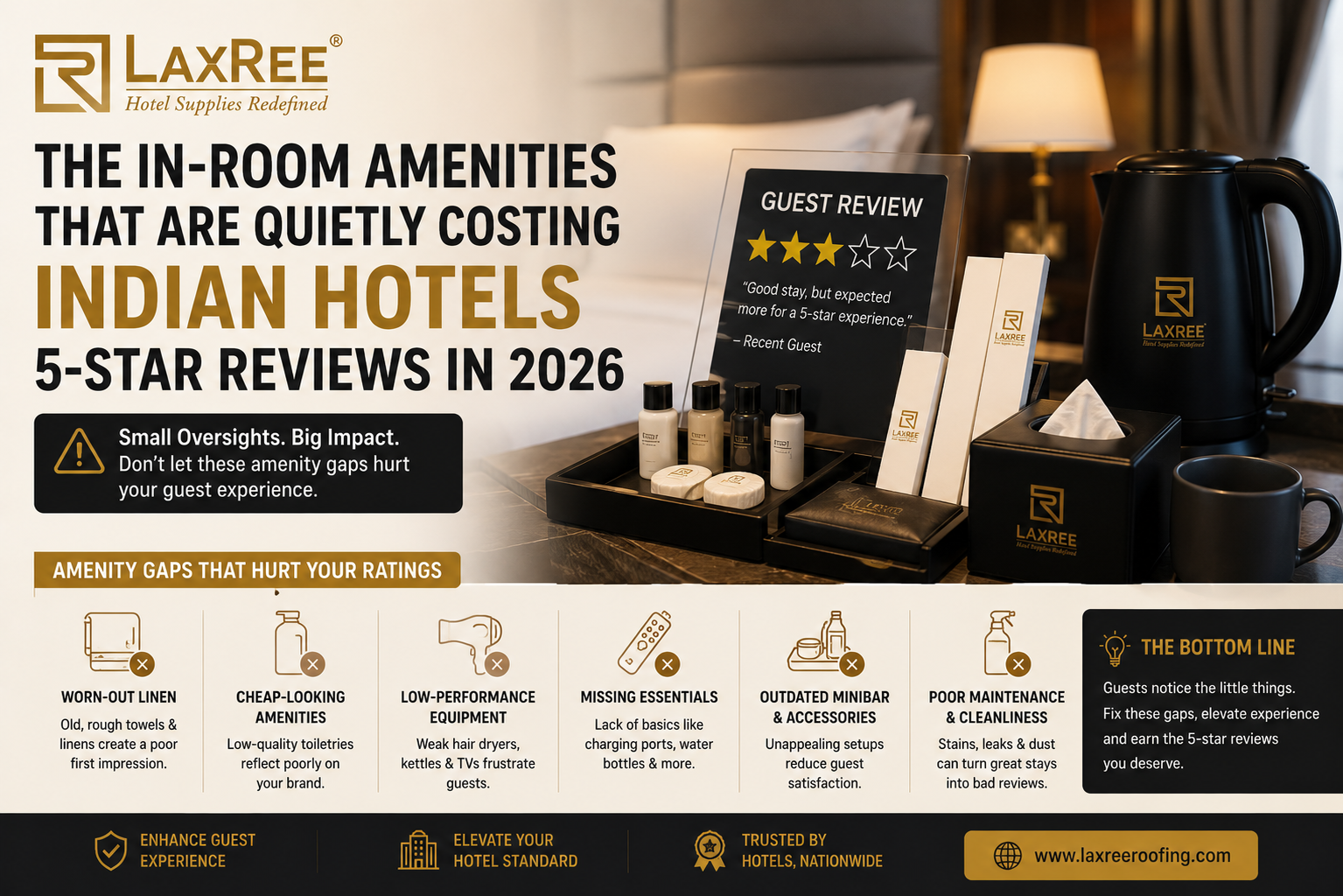
The In-Room Amenities That Are Quietly Costing Indian Hotels 5-Star Reviews in 2026
Your front desk team is well-trained. Your location is good. Your rooms are clean. And yet your Booking.com score sits at 7.6 when it should be 8.4.
The gap between where your hotel’s OTA score is and where it should be is almost always a product problem — not a service problem.
Guests do not leave 3-star reviews because the staff were unfriendly. In the majority of Indian hotel OTA reviews, the low scores trace directly back to specific in-room amenity failures: a kettle that took five minutes to boil, a mini bar that hummed audibly all night, towels that felt like sandpaper, a charging port that stopped working, bathroom accessories that looked like they came from a roadside market.
Each of those failures costs your hotel real money — in OTA ranking position, in conversion rate, in repeat booking rate, and in the ADR premium you lose when your score stays below the threshold where guests willingly pay more to stay with you.
This is the complete 2026 guide to the six in-room amenity failures driving the most review damage in Indian hotels — and the specific fixes that resolve them.
Why Amenity Failures Hit Review Scores Harder Than Almost Anything Else
Before the six failures, it is worth understanding why in-room amenities punch above their weight in OTA review scores.
Hotel review platforms weight guest scores by experience intensity. A smooth, pleasant interaction with reception generates a neutral-positive impression. A mattress that created genuine physical discomfort, or a kettle that ruined a morning routine — these generate strong negative impressions that translate into lower individual scores and specific negative text that appears in the review.
Specific negative text in reviews is particularly damaging. Booking.com and Google both surface frequently mentioned themes in hotel search results — so “thin towels” or “mini bar was noisy” appearing in multiple reviews creates a highlighted negative that potential guests see before they even click on your property.
The fix is almost always a procurement decision — and often a far less expensive one than hotel owners expect.
Failure 1: Linen That Feels Rough and Thin
What guests say: “The sheets felt rough and scratchy.” “Towels were thin and rough.” “Bedding was uncomfortable.”
The review score impact: Linen quality affects Booking.com’s Comfort sub-score and Cleanliness sub-score simultaneously. Combined impact on overall score: −0.3 to −0.8 points — the largest single amenity impact of any category.
Why it happens: Most Indian hotel linen procurement is driven by price per piece, not by thread count or GSM specification. The result is 180TC polycotton bedsheets and sub-400 GSM towels — products that look fine in a supplier catalogue but feel rough and thin to a guest who has any reference for quality linen.
The specific thresholds that matter:
Bedsheets below 200TC polycotton feel noticeably rough on skin — particularly at night, when the guest has prolonged body contact with the fabric. At 250TC 100% cotton, guests reliably describe sheets as “soft.” At 300TC+, guests say “luxurious.”
Towels below 450 GSM feel thin and inadequate. At 500 GSM, guests describe towels as “good.” At 600 GSM, guests say “plush” and “thick” — the language that appears in positive reviews.
The fix:
For 3-star properties: upgrade to 80/20 polycotton 250TC bedsheets and 500 GSM bath towels. For 4-star: 100% cotton 300TC and 600 GSM. This single upgrade generates more OTA score improvement per rupee invested than any other amenity intervention — consistently, across every Indian hotel category that has implemented it.
LaxRee solution: LaxRee’s hotel linen range covers the full specification bandwidth from 3-star to 5-star — with documented GSM, thread count, and fabric composition for every product. Physical samples available before bulk order commitment.
Failure 2: The Kettle That Ruins the Morning Routine
What guests say: “The kettle took forever.” “Had to wait ages for tea.” “Kettle kept cutting off before boiling.” “The kettle left brown marks in my cup.”
The review score impact: Kettle failures affect Comfort and Facilities scores. Impact: −0.1 to −0.3 points — smaller than linen, but generated disproportionately by business travellers who use the kettle every morning and notice every friction point.
Why it happens: Two causes. First, most Indian hotel kettles are household-grade products purchased at household-grade prices — 1,200–1,500W units with exposed coil elements that accumulate mineral scale rapidly in hard-water regions (Rajasthan, Delhi, Gujarat, UP). Second, no self-clean protocol exists in most housekeeping SOPs — scale builds until it starts discharging as brown deposits onto the guest’s morning cup.
The specific failures:
A 1,200W kettle takes approximately 4–5 minutes to boil one litre of water. A 2,000W hotel-grade unit does the same in under 90 seconds. To a guest in a hurry before a meeting, that difference is not trivial — it is 3.5 minutes of frustration in the first hour of the day.
Mineral scale discharge — the brown or rust-coloured deposits that appear in a cup when a scaled kettle boils — is an immediate, visceral hygiene complaint. It contaminates the guest’s drink and generates a strong negative impression that rarely stays out of their review.
The fix:
Replace sub-1,800W units with 2,000W+ rapid boil commercial kettles with concealed disc elements and self-clean function. Add a self-clean protocol to the weekly housekeeping deep-clean schedule. At LaxRee’s B2B volume pricing for a 60-room property, the total cost of this upgrade is often recovered in the first year through the OTA ranking improvement alone.
LaxRee solution: LaxRee’s hotel kettle range — 2,000W+, 304 stainless steel concealed disc element, auto shut-off, self-clean, 360° cordless base — specified for Indian hard water conditions. Available with coordinated tray sets, cups, and sachet organisers for the complete in-room beverage presentation upgrade.
Failure 3: The Mini Bar That Hums All Night
What guests say: “The mini bar was so noisy, it kept us awake.” “Fridge made a constant humming sound.” “Had to unplug the mini bar to sleep.”
The review score impact: Mini bar noise affects the Comfort score directly — because it affects sleep quality, which is the single most important driver of Comfort scoring. Impact: −0.2 to −0.5 points — disproportionately large because sleep disruption affects the guest’s entire perception of the stay, not just one moment.
Why it happens: Compressor-based or older mini bar units develop increasing noise as their compressor components age. Many Indian hotel mini bars are running units that are 8–12 years old, well past their expected service life, with compressors that are significantly noisier than when new.
The specific problem with compressor mini bars: A compressor refrigeration cycle has a duty cycle — the compressor switches on and off repeatedly throughout the night. Each switch-on produces a loud start-up sound. At 2am in a quiet room, this is enough to disturb sleep. As the compressor ages, the noise at start-up increases.
The fix:
Replace aging compressor units with absorption or thermoelectric mini bars. Absorption technology operates on a heat-driven chemical cycle with no moving parts — producing near-zero operating noise. Thermoelectric units use solid-state Peltier technology with only a small cooling fan — typically 25–30 dB, well below the ambient sound of an air conditioner.
Both technologies eliminate the “noisy mini bar” review complaint entirely. The investment pays back in Comfort score improvement within the first review cycle post-replacement.
LaxRee solution: LaxRee’s Essential Series (absorption) and Premium Series (thermoelectric) mini bar range — near-silent operation, commercial duty cycle rated, available in multiple capacities. The Premium Series includes glass-door options that increase minibar consumption revenue simultaneously with eliminating the noise complaint.
Failure 4: Bathroom Accessories That Undermine a Premium Room
What guests say: “Bathroom felt old and cheap.” “Bathroom accessories were very basic.” “The bathroom looked like it hadn’t been updated in years.”
The review score impact: Bathroom accessories affect the Cleanliness and Facilities sub-scores — not because the bathroom is dirty, but because mismatched or low-quality accessories create a visual impression of neglect that reads as uncleanliness even when the room is spotless. Impact: −0.1 to −0.3 points.
Why it happens: Bathroom accessories — tissue holder, soap dish, vanity tray, cotton pad tray, towel holder, waste bin — are typically purchased as individual, uncoordinated items from different suppliers at different times. The result is a bathroom with five objects that do not visually belong together, communicating an assembled rather than designed space.
The specific problem: Guests who stay in well-designed properties — or who browse design-forward hotel content on Instagram — have a calibrated sense of what a premium bathroom looks like. A matte black coordinated bathroom accessory set reads as premium. A random collection of chrome, white plastic, and beige ceramic reads as budget regardless of the room’s other qualities.
The fix:
Replace uncoordinated bathroom accessories with a complete, matched-finish set — tissue box holder, soap dish, rectangular vanity tray, dual-sided hand towel holder, cotton pad and swab tray, trash can — all in the same material family and finish. The Pomelli collection achieves this in a deep matte black that photographs extremely well and reads as a considered design investment.
LaxRee solution: The Pomelli collection by LaxRee — a complete 9-piece coordinated bathroom accessory set in premium matte black finish, specifically designed for hotel washroom applications. One specification, one supplier, one coordinated result that transforms bathroom perception in under an hour of installation.
Failure 5: Charging Infrastructure That Doesn’t Work
What guests say: “No wireless charging.” “Not enough USB ports.” “Couldn’t charge my laptop.” “Had to use my own adapter as there was nothing useful.”
The review score impact: Charging and tech amenity failures affect the Facilities score — and this is a rapidly growing complaint category in 2026. Impact: −0.1 to −0.3 points for properties where this is now a competitive standard. More importantly, it is cited specifically in reviews by the business travel segment — the highest-value repeat booking segment for most Indian hotels.
Why it happens: Many Indian hotel rooms were specified 4–6 years ago, when a single USB-A port on a wall adapter was considered adequate. Today, a business traveller arrives with a wireless-charging phone, a USB-C laptop, wireless earbuds, and a smartwatch — all requiring simultaneous charging, with none of them well-served by a 2019 room specification.
The specific gap: A room without Qi wireless charging leaves every iPhone 8 and above user — and every current Android flagship user — without their preferred charging method. A room without USB-C leaves laptop-carrying business travellers hunting for a wall socket for their laptop charger. A room with a single USB-A port creates device charging queues that frustrate guests in every morning routine.
The fix:
Install a quality docking pod with Qi-certified wireless charging (minimum 15W), at least one USB-C port (ideally with USB Power Delivery for laptop charging), and at least one USB-A port. A single well-specified docking pod replaces the entire charging problem with a single, clean desk solution — simultaneously eliminating every charging complaint and generating a specific positive review mention (“loved the wireless charging”) from the guests who use it.
LaxRee solution: LaxRee’s premium docking pod range — LaxRee-branded gold and black finish, Qi-certified fast wireless charging, Bluetooth speaker integration, USB-C and USB-A ports, and room telephone functionality. Specifically designed for premium Indian hotel room positioning — the product visible in room photography as a design-forward tech statement.
Failure 6: Linen That Has Simply Aged Out
What guests say: “Sheets looked old and worn.” “There were stains on the towels.” “The towels smelled musty.” “Pillows were completely flat.”
The review score impact: Aged linen failure affects Cleanliness and Comfort simultaneously — the two highest-weighted Booking.com sub-categories. Combined impact: −0.3 to −0.8 points. This is distinct from Failure 1 (under-specification) — this is correctly-specified linen that has exceeded its commercial service life and has not been replaced.
Why it happens: Most Indian hotels have no formal linen replacement cycle. Linen is replaced reactively — when it tears, stains permanently, or becomes too visibly degraded to ignore. This means the property is consistently operating with a proportion of rooms containing linen that is past its service life but has not yet crossed the obvious visual threshold that triggers replacement.
Guests with fresh eyes — unlike housekeeping staff who see the same linen daily — notice immediately. The yellowing that develops gradually over 200 wash cycles, the compression of pillow fill that happens incrementally, the slight roughening of towels that comes with each laundry cycle — these become clearly visible to a first-time guest who has no gradual adjustment.
The fix:
Implement a formal linen replacement schedule rather than reactive replacement. For hotel-grade 500–600 GSM cotton bath towels: replacement at 100–150 wash cycles — approximately every 18–24 months at standard occupancy. For 300TC cotton bedsheets: replacement at 150–200 wash cycles — approximately every 2–3 years. Build this as a line item in the annual procurement budget, not as an emergency expense.
LaxRee solution: LaxRee’s B2B linen supply model supports ongoing replacement procurement — same specification, consistent quality, available for reorder at volume pricing without requiring a new procurement process each cycle. Setup the annual replacement schedule once; execute it predictably each year.
What These Six Fixes Are Worth in Real Revenue
The combined OTA score improvement from addressing all six failures depends on how many are currently active at a given property. Across Indian hotel properties that have implemented targeted amenity upgrades, the typical documented score improvement is 0.5–1.2 points on Booking.com over a 6–12 month period post-upgrade.
What a 0.8-point Booking.com score improvement is worth:
For a 60-room hotel currently scoring 7.6 on Booking.com, rising to 8.4:
- Search position improvement: approximately 20–30% higher position in Booking.com search results for the property’s market
- Click-through rate improvement: approximately 15–20% more property page views from the same search traffic
- At current occupancy (65%) and ADR (₹3,500): additional annual room revenue of approximately ₹28–42 lakh
The six amenity fixes described above, implemented across a 60-room property at 4-star specification, typically cost a total of ₹15–28 lakh — including linen upgrade, kettle replacement, mini bar replacement, bathroom accessory replacement, and docking pod installation.
Payback period: less than 12 months.
The LaxRee Amenity Audit: Start With What’s Pulling Your Score Down
LaxRee Amenities offers B2B procurement support for Indian hotel owners implementing targeted amenity upgrades — from a single failing category to a full-property specification overhaul.
Every product category discussed in this guide — hotel linen, kettle sets, mini bars, bathroom accessories, docking pods — is available through LaxRee’s 700+ SKU catalogue, with physical samples before bulk commitment, volume pricing at hotel scale, and coordinated supply across all categories.
The starting point is identifying which of the six failures are active at your property. Your last 50 OTA reviews will tell you — categorise the negative comments by amenity type, and the priorities become immediately clear.
Ready to identify your property’s amenity gaps? Talk to LaxRee today.
📧 info@laxree.com | contactus@laxree.com 📞 +91 99822 86662 🌐 laxree.com
📍 Plot No. 1 & 2, Harbilas Sharda Marg, Civil Lines, Ajmer, Rajasthan


